
March 31, 2003
THIS IS THE WAR WE'RE
THIS IS THE WAR WE'RE MISSING, GUYS
God save us all. Or, as the Iraqis might say, al hamdilillah.
THE MIXED BLESSING OF THE
THE MIXED BLESSING OF THE M1 TANK
Not to harp on a point, but we're beginning to see more of the weaknesses of the M1/Bradley armour system in Iraq. It's still early, but you can already see more of the problems than you could in the previous outing.
Now, of course, the M1 tank is, when in its element, all but invincible. Even when something goes wrong, it's immensely survivable. But every plus comes with minuses.
First and foremost is the sheer weight of the tank itself, and the restrictions this places on its mobility, particularly on where it can cross rivers. The M1 isn't well-regarded in the Bosnian theatre (nor are other heavy tanks)... experienced soldiers prefer a slightly lighter tank like the Leopard I, solely because it can get to more places more easily. A big part of this problem is bridges... very few can take repeated crossings by M1s. In heavily-irrigated Mesopotamia, we've already seen at least one M1 temporarily disabled when it BROKE the bridge it was crossing (during the 7th Cavalry's encirclement of Najaf... no casualties, and the tank was later recovered).
More worrying than that risk is the predictability that the reliance on only a few bridges imparts to American movements. This produces chokepoints that a defender can take advantage of... this was highlighted by the most tragic M1 loss so far, when a Marine tank driver was apparently shot and killed by a sniper while crossing a bridge, and the tank plunged off into the Euphrates, killing 3 others.
Another problem is showing up in the area of interoperability. Both the Army and Marines use M1s as their tanks now, but there is still a problem with infantry carriers. The Army's Bradley is too heavy for Marine use or air-portability. Instead, the Marines are currently using a combination of Amtracs (armoured amphibious assault vehicles) and Canadian-made wheeled LAVs. The Amtracs, which have run longer and farther from the sea than perhaps any amphibian in history, are beginning now to break down... there is no prospect of replacing them, forcing three-quarters of the Marine forces in-theatre into an increasing reliance on truck transport. The army units can't help them with spare parts, because they're using Bradleys.
But of course, the biggest problem with the M1 is the massive logistical tail it produces in-theatre. At 1.8 miles per gallon, the tank eats fuel convoys for breakfast, lunch and dinner. Keeping the M1s in theatre is using up a significant portion of the army's logistical capability. Even getting them into theatre en masse is impossible without shipborne transport, as we're seeing now... this adds weeks to a heavy division's deployment time, if not months. Relying on M1s can, in a global sense, make the American forces less flexible.
All that could be forgiven, easily, if the tank was still getting the remarkable kill ratios against other tanks it racked up in 1991. But it can't, of only because the Iraqis have no interest in making that battle happen. They've concentrated their T-72s, which are only marginal against an M1 anyway, in Baghdad for the final battles. Their really old tanks, the T-55s, are either in the north intimidating Kurds, or piled into Basra, where they've been making nice target practice for the British. So far the Americans have seen few if any tanks facing them... this is almost certainly intentional. And in city fighting, which is ever more a part of this campaign, the M1, like all heavy tanks, loses much of its advantage, if only because it can't slew its huge turret in the narrow streets. Nothing the Americans or British have faced to date couldn't have been handled as easily, with about as much loss, by an old M-60, Leopard I, or Chieftain... the 105mm gun-armed tanks of a previous generation.
Does this mean the day of the Main Battle Tank is over? Hardly. The presence of M1s is, in large part, what makes the Americans' position around Najaf, which would otherwise seem rather precarious, almost completely invulnerable. They have at least a few good days yet. But this war is almost certain to give impetus to people's search for another basket to split the army's eggs between. For instance, some people have been saying that the regular army's five heavy divisions in the States and Germany should be reduced to four, in a tradeoff with the army reserve for some of the essential non-combat specialist trades the reserves supply, to disentangle foreign deployments from their heavy reservist reliance. This will be certainly seen to have more merit now, with tanks in the States that can't be shipped and large numbers of disgruntled reservists. The planned "Stryker" brigades, which propose to replace the M1 with a 105mm wheeled direct-fire support vehicle, air-portable, amphibious, and interchangeable with the Marines' new vehicles, should also get a boost from the experience of M1s in Iraq. If America truly seeks the kind of global "constabulary power" role Wolfowitz and Perle, et al seek for it, then it's clear now, more than 2 weeks ago, that the M1 can only ever be part of the answer.
THE OTHER DOG THAT HASN'T
THE OTHER DOG THAT HASN'T BARKED
Besides the T-72s, there's another dog that hasn't barked in the night yet. U.S., British and Australian special forces have owned the western corner of Iraq for nearly two weeks now. If Iraq had any long-range SSMs left, particularly ones with chemical capability, that's where they would have been... can't hit Israel from anywhere else in the country, after all. Isn't it unusual that we've yet to see one turn up? Or was Hans Blix's contention that there were no Scuds left, and no chemical warheads for them either, right on the money after all? And if so, does that mean the elite of the elite of three armies have spent two weeks chasing, well, nothing at all? Away from a more useful role, like in, say, the north of Iraq? Just asking.
UPDATE: Den Beste comments. If we disagree, it's only on whether the military and its civilian masters could long keep news of a Scud find or similar discovery quiet, no matter the risk to operational security. I frankly doubt they could have kept it out of their briefings this long if they knew. The political payoff is obvious, and the risk to other special ops more or less minimal.
I'd also say it's questionable whether SF played any role in securing the oil fields around Basra. We know that two full brigades of Marines, covered by British armour, drove into them at high speed the first day... and because they had to do that first, before 1 Mar Div could double back to Nasariyah, the American advance north more or less lost 24 hours. If SF were heavily involved and not doing something else instead in those first crucial hours, and the Americans STILL lost that day, endangering their coup de main attempt on Baghdad, then the price of those oil fields was very high, indeed.
THE PROBLEM, YOU SEE, IS
THE PROBLEM, YOU SEE, IS ALL THE LYING... PART 2
When spin fails:
"I have seen one report of a soldier who said he HAD an MRE. I have seen one report. There is no indication of any widespread [supply] problems whatsoever."
--Pentagon spokesperson Victoria Clarke, March 29
"This division is out of rations... we are at zero balance on food." -- Brig. Gen. Charles Fletcher, the commander of the Divisional Supply Group for 3rd Infantry Division, New York Times, March 27
OUR CHIEF WEAPON IS SURPRISE.
OUR CHIEF WEAPON IS SURPRISE. SURPRISE AND FEAR. FEAR AND SURPRISE...
Sgt. Stryker has what I've decided to cryptically call a "Who wants ginger snaps?" moment. (Hint: "Deep Space Homer.") There's been a lot of these recently on the warblogs... the other, secret Marines your government hasn't told you about will invade through Jordan, the 1st Armoured will descend by spaceship, etc. The only reason I can see for it is that perennial (and perennially wrong) assumption that soldiers are ALWAYS smarter than the journalists who cover them. Don't buy it. Tactical surprise is certainly still possible in this war (I suspect the encirclement of Najaf by 7th Cavalry will likely be long studied, for instance), but I'm increasingly convinced that strategic, or even operational surprise, may not be possible in a free-communication culture. Indeed, one notable thing about this war so far is how little the Iraqis were surprised by events... after all, their best division, the Medina Armoured, WAS prepositioned right in the path of the American advance, and is now holding it up successfully, at least for the moment... hardly a sign of poor prewar intelligence on their part.
THIS WAS DISAPPOINTING READING Sy
THIS WAS DISAPPOINTING READING
Sy Hersh, in the New Yorker:
Instead, [Rumsfeld] relied on the heavy equipment that was already in Kuwait—enough for just one full combat division. The 3rd Infantry Division, from Fort Stewart, Georgia, the only mechanized Army division that was active inside Iraq last week, thus arrived in the Gulf without its own equipment. “Those guys are driving around in tanks that were pre-positioned. Their tanks are sitting in Fort Stewart,” the planner said. “To get more forces there we have to float them. We can’t fly our forces in, because there’s nothing for them to drive. Over the past six months, you could have floated everything in ninety days—enough for four or more divisions.”
Okay, well, that changes some assumptions. I had assumed with the lengthy buildup time (over a year, really), that at least the 3rd Mech Inf had brought its own equipment, and there was still some of the prepositioned stock in place for the follow-on forces. If not, then even elements of 4th Mech Inf may well not see action until Day 30 now. My earlier prediction of a 7-week war goes to 8-9 on the strength of that one quote alone... I can't see how they're out of this much before the middle of May at the earliest now. Wow. They had so much time. But still no corps artillery, no corps logistics support, and now this.
I'm still not convinced it's just the Pentagon civilians at fault, though. It may simply be the unwieldiness of American heavy divisions today. They're just too heavy to move, it seems. What good is a military formation that even its defenders concede now requires six months to fully deploy? Rumsfeld, et al, in ruling out the use of bigger formations in Iraq, might have taken the wrong course in this campaign, but ultimately with the right reasons in mind... that we are at the end of the era of heavyweight combat forces. In America's next major war, you can bet nearly everything will have to fit on a plane somehow, if only to avoid what's going on now.
WHAT'S WRONG WITH THIS ANALYSIS?
WHAT'S WRONG WITH THIS ANALYSIS?
OxBlog's got a link up to a possible explanation for the American strategy, which continues to baffle people. In short:
Franks could not have reached Baghdad in under a week with two mech infantry divisions abreast. The logistical tail from Kuwait would not have supported it.
It is certainly possible this is correct: it would be impossible to evaluate without logistical information not in common possession. But it still doesn't mean the Americans are on plan. The reason is that the Americans had choices in which units they sent to this war. To simplify, they sent 1 heavy (3rd Inf), 2 medium (Marines and Brits), and 1 light division (101st). If this is where the Americans expected they might be on Day 12, essentially unable to move forward because of the lack of a second heavy division, they could have subbed one into the starting lineup. Or, as has been suggested here previously, they could have created an ad hoc heavy division by merging Marine and UK units. But they didn't do that, so obviously they didn't anticipate this situation. So obviously they were expecting to fight a different kind of war... a war that ended relatively quickly and would require large numbers of lightly armed infantry for pacification.
They didn't get it, and that's fine... war's don't work out the way you want, and losses really haven't been that high. But there's no point in pretending that the situation at the moment is anywhere close to the original plan. It was a coup de main attempt that failed.
Incidentally, I believe both Rumsfeld and the generals are right... this was the armed forces' plan, and he didn't rewrite it. It would have been more subtle than that. The choice would have been between the coup de main plan, with an understanding that failure would mean the war would go on for a couple months instead using a backup Plan B, or a different initial plan that would have taken longer to mount, would have been less ambitious but more certain, with more troops, and would still take... a couple months. Even without Rumsfeld's well-known predilections for light forces and military revolutions, the first option would still have looked tempting.
In a way, the Oxblog commentator is half-right. In order to prove Rumsfeld wrong, the second guessers have to come up with a plan that would have at least a small chance of winning this war in a week, as "Iraq Plan A" promised to. There's lots of plans that would have promised to win the war in two months, including the Plan B the Americans are no doubt executing now: by mid May, we'll know the success of that one, as well. One can certainly fault the Bush administration for anything they may have done to raise expectations of a quick war, but it doesn't seem right to fault them solely for playing a non-risk averse game here. A "quick war" strategy was low-odds, but high payoff.
WHAT EXACTLY IS THE REPUBLICAN
WHAT EXACTLY IS THE REPUBLICAN GUARD DOING?
People are trying to figure out the RG's strategy, and apparent moving around of units around Baghdad. It's kinda simple... outside the city the Guard has three really good armoured divisions (Hammurabi, Medina (probably the best) and Nidah). They are the units with those T-72s we were talking about. They also have two divisions of infantry, without significant armour or artillery assets, the Nebuchadnezzar and Baghdad. (If this was 1814, we'd call them the "Young Guard.") They're probably somewhat better than the regular army's worst units, and not as good as its best ones. The final two Republican Guard divisions outside Baghdad proper are still well to the north of the city, around Tikrit and Kirkuk... they're not particularly well-equipped units either. So practically all the Hussein regime's remaining fighting power is in those three armoured divisions.
The Iraqi strategy throughout has been first to delay the approach to Baghdad, and second to preserve their combat power. The Medina's taking the brunt of the Americans' air and artillery attack right now: the Hammurabi and Nidah are catching a bit, too, but they're still very much to the north and east of the city, and so largely out of helicopter and artillery range. As near as I can figure, Hammurabi's still watching for an airmobile deployment north of Karbala, while Nidah's positioning to catch the Americans with a counterstrike if they try to take the war across the Tigris at any point. In fact, the threats of counterstrike from those two units is what's basically hemming the Americans into the Euphrates Valley, forcing them to come through the Medina Division to get to Baghdad. (If the Americans had had a "second fist" ie, a second heavy division, they'd have more options right now, obviously: the Marines or 101st Airborne would have some trouble with a Republican Guard armoured division, but the 4th Mech Inf, for instance, certainly won't when it shows up.)
The Iraqis know that when the Medina and 3rd Inf divisions finally clash, the Medina Division will lose, and they will be forced to finally withdraw into Baghdad proper. So their one major move was to move forward their two weaker RG divisions, their Young Guard, on either flank of the Medina, to delay that decisive clash still further. (The Iraqis know if those two are destroyed the Medina can keep fighting, but not vice versa.) It's working... the Nebuchadnezzar and Baghdad Divisions' positions are now soaking off a lot of the air and ground combat power that would otherwise be focussed on the Medina. Lacking substantial armour or artillery support, they're speedbumps, really, but they are buying hours, even days of time with their lives.
WEEKEND WRAPUP Okay, here's the
WEEKEND WRAPUP
Okay, here's the significant developments of the weekend that one can see:
*the 82nd Airborne Division's brigade in Kuwait has moved to take over the clearing of Samawah, on the main American supply route. That pretty much rules out any significant new airborne operation in Iraq for the time being... so the 173rd brigade in the north is likely to remain on its own for a while. Sandro Contenta of the Star reports that he has yet to see any U.S. AFVs with them, by the way, suggesting any plans to strengthen the 173rd with heavier units are taking some time.
*the 101st Airborne is now fully dedicated to the beseiging and clearing out Najaf.
*an Iraqi resistance in Diwaniyah has been bypassed and cut off, with American forces from the 3rd Infantry Division now coming up to Hillah. The 2nd Brigade of that Division has been fighting with the Iraqi Nebuchadnezzar Division in Hindiyah. Map updated.
March 30, 2003
QUOTE OF THE WEEKEND "...The
QUOTE OF THE WEEKEND
"...The 3rd Infantry [Division] was sent to war with only one battalion of MLRS rocket-launched artillery, a powerful long-range system that can reach out 30 miles and obliterate more than a third of a square mile of enemy soldiers or enemy tanks. Usually, it would have brought two brigades of MLRS launchers, about six battalions."
--Joseph Galloway, Miami Herald
Been over the news, and while there's still a couple question marks I need to tease out, it's notable how so very little has changed in the last 48 hours. The 101st Airborne appears to have been given that task of occupying Najaf, which would be a key acquisition to continue the advance.. The Iraqis, on a line from Karbala to Hillah, are being pounded from the air, still... the Marines are biting and holding little non-significant chunks of Mespotamian farmland, and the British all still completely stalled. In fact, it's fair to say that after 4 days of rapid advance, the American move forward basically halted last Sunday, and everything since then has been consolidation and positioning moves. I defy anyone to tell that from the last week of newspaper headlines alone, though: the time lag between reality change and expectation change seems to be about a week. So we had a week's worth of "Americans march on Baghdad" headlines when they weren't going anywhere, and now this week, when I fully expect they'll start moving again, we'll get a lot of "Are Americans stalled?" heads.
THIS PROBABLY COUNTS FOR ANOTHER
THIS PROBABLY COUNTS FOR ANOTHER OF MY 15 MINUTES
I only got the two good quotes in the recent John Allemang piece on warblogs in the Globe, but it was still a tremendously pleasant interview. He was clearly working hard at trying to understand this corner of the blogging phenomenon. Would that every reporter took such care. Cheers, John: it was nice talking to you again.
Just got back in from a weekend running a rifle range... rest assured we shall be returning to our regularly scheduled war shortly, as soon as I manage to catch up on the last 48.
March 28, 2003
BRIEF HIATUS I'm out of
BRIEF HIATUS
I'm out of town working this weekend. Posting to resume Sunday afternoon.
NOTES FROM THE MORNING TV
NOTES FROM THE MORNING TV NEWS
CNN reports the Guard's Hammurabi Division is shifting to face south, and the Adnan Division is coming down from the north. The Medina Division, the main roadblock to Baghdad's perimeter at the moment (see map) is reportedly at 65 per cent strength.
The Marines' secondary thrust from Nasiriyah to Kut has reportedly reached Qal at Sukkar. Map updated. They should be close now to the Republican Guard Baghdad Division, which I believe to be in positions in and north of Hayy. The main Marine thrust is now northwest of Diwaniyah, and may have already cut that city off. Marines with that formation report they're down to one meal a day's rations.
QUOTE OF THE DAY: "Meanwhile, COSCOM itself has only 150 heavy transport trucks for an operation that Army planners estimate requires 700. 'We're going to war not with what we need, but with what we have on the ground, so we threw away the doctrinal books on this operation a long time ago,' said [logistics commander Brig. Gen. Charles] Fletcher, noting that his transport units also have far less maintenance support than normal." --seen on Carter's site.
HERE'S SOMETHING TO THINK ABOUT
HERE'S SOMETHING TO THINK ABOUT
In eight days of warfare we have yet to see a confirmed report of an Iraqi T-72 tank being destroyed. Not one. They have somewhere over 500 of them that can still move, as far as people can tell, all in the Guard divisions. The Medina Division, the one Guard division that's been engaged at all, certainly had 100-150 of them at least. They've been seen... just not engaged or killed yet. Not that the T-72's so special, but it is somewhat more dangerous than the tanks the Allies have been busting up, which have been only the 40 year-old T-55s so far. Just something to think about.
March 27, 2003
INCHING FORWARD 3rd Infantry's forward
INCHING FORWARD
3rd Infantry's forward element is now in the village of Kifl, halfway on the map between Hillah and Najaf.
LOOKS LIKE WE'RE REACHING THE
LOOKS LIKE WE'RE REACHING THE END OF THIS LITTLE EXPERIMENT
Take a look at those quotes again, below. A logistics brigadier general, talking to the COSCOM commander, about the highest-priority traffic a division can have, broadcast IN THE CLEAR by the Scripps news service to any Iraqi with a web browser. And the CORPS commander, expressing his deepest personal doubts about the progress of the war.
This is the kind of communications traffic that in past wars the highest-level codes were reserved for. Now it's being sent to the enemy in real time. This is not sound. The American forces can't allow this to continue much longer. What makes marginal sense in a short cakewalk war makes zero sense now.
Sitting here, looking at a couple websites, I've been able to build up a 90% accurate picture of the strategic situation. (Not to put on airs... it's not hard.) There have been no surprises, no aces up Gen. Franks' sleeve that I and others didn't see coming hours or days off. Everyone in the world knows, if they care, roughly when the next U.S. armoured division is likely to arrive in Kuwait, how many tanks the U.S. lost yesterday, and to what... imagine how much more you'd have if you were the Iraqi commander and you also had the input of your own recce assets to feed into that.
In 1991, using skilful misdirection and overwhelming aerial superiority, the Americans basically denied the Iraqis ANY intelligence about their location or intent. When the hammer fell, it fell, for the Iraqis, out of fricking nowhere. Not this time. All that's been ceded over. Now everyone knows where the Americans are: it's the knowledge of the Iraqi situation that's imperfect.
Watch for the embeds to start being left behind or clawed back. We've already seen one reporter kicked out of theatre, for saying something actually rather innocuous. It was probably more to encourage the others. In fact, the lull you're seeing today in news probably has less to do with actual quiet on the ground, and more on reporters and their minders trying to establish what the new rules are going to be. And expect the generals to start shutting up.
UPDATE: Den Beste comments. Just to be clear, it's not the exposure of some plain positional data by itself that bothers me. That would have to have been assumed as soon as you brought reporters along with cameras: I find myself getting far more cues from images than the words anyway. What concerns me is the obvious complete loss of ANY secrecy if reporters are listening into general-to-general conversations and reporting the results the next day to the world, censorship-free. That speaks to a general loss of perspective in the American camp over whether operational security or the desires of embedded reporters for total access takes primacy. That can't be sustainable. Yes, you can have the reporter there, but that information could have been released a few days later, after the food arrived... it was just stupid to have it out in real time like that.
Plus, there's a problem with his anti-thesis... that the Americans are trying to lure the Iraqis out by being upfront about their position and plans. Take the counterattack he points at... that happened because the Americans had cut Najaf and its defenders off (the fact 7th Cav was exposed on the near bank of a major obstacle, and the weather was adverse, were no doubt also factors). The news media had nothing to do with that: the attack had been made and failed before most people watching the news, including myself, were clear on 7th Cav's route and intent, for one thing. Yes, I agree the Americans would prefer a fight outside Baghdad, but there's no connection between that and your commander telling the world, including even his own men and their families at home, that they are out of food and their resupply is nowhere to be found. (Frankly, if anything, it would only confirm the Iraqis' beliefs that their economy of force strategy was succeeding and that they should continue to hunker down, or keep picking away at the rear areas, instead. The only thing more stupid than broadcasting everything in the clear for purely PR reasons would be an nearly intact American mechanized division trying to play the "wounded bird" act. No one's that naive.)
DAILY WAR NOTES The main
DAILY WAR NOTES
The main body of the 101st Airborne is finally on the move, by truck, although 3rd Brigade appears to be already with 3rd Mech Inf near Najaf, possibly subbing in to the order of battle for 3rd Brigade of that division, which seems to still be held up at Samawah. The Marines seem to be due east of Diwaniyah, more or less (a Christian Science Monitor reporter was booted yesterday for saying that they were on the main highway, 100 miles from Baghdad). Map updated accordingly.
The big question mark today is how bad the fighting in Najaf and Diwaniyah, significant cities now more or less cut off by the American advance, is going to be. If the Americans can clear them quickly, they can be moving north again by the end of the weekend. If they run into Nasariyah-type resistance, it could be middle of next week.
The 173rd Airborne Brigade, with a battalion of armour attached (about 30 M1 tanks) is at Harir airfield, 75 km northeast of Irbil. They probably have the combat power to push on Irbil in a few days, and to act as a lightning rod for a larger Kurdish force. They probably don't have the power to push onto the oil fields at Kirkuk, at least not by themselves. Their probable main role is to create enough of a demonstration to attract the attention of the two Iraqi divisions, the Adnan Division in Mosul and the Abed Division in Kirkuk, that would have had enough motorized lift to head south if a northern option didn't materialize soon. The rest of the Iraqi force in the north can be assumed to remain in position until overrun, regardless... again, the Iraqis seem to have concentrated all the transport vehicles that can actually move with their Guards units... still, two fewer divisions in Baghdad is two fewer divisions in Baghdad, definitely worth the fairly minor diversion of resources. Just don't expect too much from the north. The Americans have 500 tanks in the south... at most they might be able to support 50 in the north, solely by air.
The question mark here is whether the Americans' one remaining parachute brigade, the 2nd/82nd, will also be dropped in Kurdish territory, probably to the south, closer to Sulaymaniyah. Right now the location of the first American drop can be seen to favour the Kurdish Democratic Party, the northern faction, who owns that airfield. Dropping the other brigade in Patriotic Union of Kurdistan territory might be seen to be evening the score.
GARBAGE IN, GARBAGE OUT "The
GARBAGE IN, GARBAGE OUT
"The enemy that we're fighting is different from the one we'd war gamed." -- V Corps commander Lt. Gen William Wallace, Washington Post
THOUGHTS FROM THE NEWS Two
THOUGHTS FROM THE NEWS
Two images from last night's TV stuck in my brain... it was tragic to see that 155mm SP gun blow-up... and remarkable the crew escaped... one of these days soon one of those embedded videophones is going to capture something far more tragic on live TV... the other was the residents of Umm Qasr cheering Saddam as the first food shipment from Kuwait arrived. Obviously it was a publicity stunt, but it shows how deeply embedded Saddamism still is in the "pacified" population that some loyalist felt confident enough even to start the cheering.
Quote of the night: "This division is out of rations... we are at zero balance on food." -- Brig. Gen. Charles Fletcher, 3rd Infantry Division
March 26, 2003
MIDDLE OF THE IRAQI NIGHT
MIDDLE OF THE IRAQI NIGHT UPDATE
The encirclement of Najaf also involved 1st Brigade of the 3rd Infantry Division, which is now across the Euphrates with the 7th Cavalry, the NYT reports. Map updated. The final tank tally for the operation seems to have been three... two to the Iraqis, one to an accident.
The battle seems to have begun when 7th Cavalry, after bumping up against Karbala on the west bank, doubled back about 50 miles south to sneak across the Euphrates near Samawah, then drove 50 miles BACK north on the east bank to capture the first of the Najaf bridges from the other side. Nice work, that. CNN's Walter Rodgers' cryptic comments on Tuesday morning our time (see post below) are cleared up. As I said, no new ground advances... but still a LOT of fighting as the Americans consolidate and regroup. They need to clear out Najaf, and then also Diwaniyah, to have a secure paved road back to Kuwait, and a firm base going into Phase Two.
UPDATE: More on the AT-14 Kornet missile, which is the supposed Abrams-killer from yesterday.
UPDATE, 1815: We're hearing 173rd Airborne Brigade is in play somewhere in North Iraq tonight. The 173rd is known as the "secret" American airborne force because it's not part of either of the two famous paratrooper divisions... Also, it seems clear by now that at least one brigade of the Iraqi 6th Armoured Division are also in Basra and took part in today's spoiling attack. The Iraqi regular army is putting up a better fight than anyone expected.
You'll see in the papers no doubt soon that this was somehow a day of attacks by the Iraqis on all fronts. I'm not convinced of that, actually. The center of the action for now is still the Najaf fight. The Medina Division certainly seems to be in play there. Another Iraqi force is moving near Kut, but that seems less an attack than a reinforcement, to prevent the Marines from running amok over Mesopotamia. That force is still nowhere close to the Americans. The Basra breakout, meanwhile, is probably really just a spoiling attack, at most timed to maximize Allied confusion over the other main battle. The Iraqis' tanks are almost as useless in city fighting as the Brits' tanks would be... they were bound to throw them out to see if they could do some damage before they were destroyed anyway... like the short range missiles fired from Basra at Kuwait, it was use them or lose them. Note, the Basra attack went southeast, to hit the lightest-armed of the British forces (3 Commando Brigade). Gaining ground here gives the Iraqis little... they couldn't hold it anyway. If they'd wanted to pretend to threaten the U.S. supply line as part of a coordinated offensive they would have attacked towards Umm Qasr (and run into 120 British tanks in doing so, and been promptly destroyed for their pains.) So instead they attacked out of Basra in a way calculated to do the most damage to the besiegers, and put the Brits back on their heels a bit. It was an attack to improve their local circumstance, not contribute to a larger "Mother of all offensives."
FINAL UPDATE: Just to be clear: I'm not saying that these attacks, involving units from at least two Iraqi corps, aren't coordinated. They are. What I'm saying is that any commentator you read or hear who says this is the Iraqis' "mother of all counterattacks," their last big push before they collapse, is arguing facts not in evidence. The Iraqis have pushed this war into at least a second week largely through skilful application of the military principle of economy of force... the evidence in so far indicates these are a set of small movements and counterattacks all along the line to improve the local situations of units while the American sledgehammer is in a strategic pause.
OKAY, FINAL, FINAL UPDATE: Barry rightly calls me out in Flitters, saying tanks aren't "useless" in city fighting. Of course they're not, either on offense or defense: I should have used a different word. What I was trying to get at is the Iraqis in Basra probably have more armoured vehicles at this point than they know what to do with from a siege perspective, so they can still afford to lose a few on the occasional sally. The alternative is just to see them steadily plinked away from the air anyway. Interestingly, the Agonist reported today (unsourced) that there were, in fact, only 14 vehicles in the sally, and the Brits managed to destroy 2.
THE HORROR. THE HORROR. Connie
THE HORROR. THE HORROR.
Connie Chung show cancelled. Chung quits.
WE MAY HAVE THE FIRST
WE MAY HAVE THE FIRST EVER MIA PIN-UP
If the inevitable tragic outcome implied herein doesn't manage to get Americans madder than they already are, little will.
A COUPLE NOTES A couple
A COUPLE NOTES
A couple things that the current reporting isn't making clear. The fighting around Najaf yesterday was all about the 7th Cavalry moving to link up with the Marines, and encircle Najaf at the same time. Najaf is a city of 400,000, and it's likely to be heavily defended, a la Nasiriyah, but if the Americans can finish resistance there they've got a good line of advance to Baghdad open to them. I may have spoken too soon when I said Karbala was likely to be the decision point... it could still be, but the tea leaves are now unclear again. What's certain is the Iraqis wanted to keep a supply line into Najaf as long as possible, and are now involved in periodic attempts like yesterday's to break the American siege, and the Americans are likewise committed to do everything they have to to keep Najaf cut off now. (Najaf is also useful to capture if the Americans just want to restore their supply lines before a further drive north.) The fact the Iraqis apparently detonated a bridge the Americans thought they captured shows how tense this is likely to get.
In Basra, meanwhile, we're seeing spoiling attacks by the Iraqis OUT. Again, this is no surprise... it's what beseiged forces do... the question mark is whether this is still all 51st Mechanized Division (you remember them, they were the formation that was reported to have entirely surrendered?), or whether 6th Armoured Division to the north has also got some of its forces into the city before the British could finish their envelopment.
THE BIG WINNER SO FAR
THE BIG WINNER SO FAR
One of the big winners out of this war, so far, institutionally speaking, is going to be U.S. army chief Shinseki and his airportable medium-weight brigades. If there was ever any doubt about their utility, it's basically vanished this week. Two simple facts guarantee that:
1) The 4th Mech Inf, the next formation in the shipping line to Kuwait, is unlikely to engage before Day 20... any other divisions could be longer than that. Heavy armoured divisions are just TOO BIG for rapid theatre deployment, especially when there's already a war on.
2) The simple fact about the Iraqi opposition is that there's nothing bigger than a T-55 tank east of Kut at this point, an obsolescent tank well within the engagement capability of any medium-weight force. (The Marines, with three brigades travelling in armoured amphibious vehicles, are basically medium-weight, and they're having no problems). The Iraqis have some T-72s that would give a medium-weight force pause, but they're all conveniently lined up against the U.S heavy troops. There's almost certainly none in Basra, or near Nasariyah.
So, if one of Shinseki's "Stryker brigades" was good to go today, it could presumably fairly quickly get to Kuwait, deploy, and take up the slack in that long front to send other, stronger, units forward, like the British 7th Armoured. Critics had said they'd be of limited utility in an Iraq war, but it's certain the Pentagon wishes they had one ready at the moment.
Here's the flipside of that, for Canadians, though... there's nothing the Iraqis have at Basra or Nasariyah that our own three mechanized brigade groups couldn't handle, either. Critics here have said that Canadian forces, which are basically all "medium-weight," would be too outclassed to do much on the ground in Iraq, so it's better to send them to Afghanistan. But if Canada had had its own integral air and sealift capability, so it wasn't drawing down American logistical resources, a unit like 2 Brigade could easily have been a valuable asset to the Americans and Brits right now.
IT'S ALL ABOUT THE TANKS
IT'S ALL ABOUT THE TANKS
The Agonist is reporting 7th Cav had 2 tanks knocked out in fighting near Najaf yesterday: crews survived. If true, those would be the first M1's EVER lost to hostile fire.
Which brings up another way to look at the fighting. The tanks are really the closest thing we have to a finite measure of American ground power. They are, up until yesterday, considered almost completely invincible. There is no enemy tank that can stand against them in an open fight. So you can measure sort of where the American-US emphasis is, largely by the location of their tank assets.
3rd Mech Inf (plus 7th Cavalry): 250-plus, near Najaf
1st Marine Div: 60 or so, SE of Diwaniyah
2nd Marine Exp. Bde: another 60, held up at Nasariyah, now headed north
1st UK Div: 120, around Basra.
So the Americans have 50 per cent of their ground combat power restoring its strength on good ground west of the Euphrates. The Marines have another 25 per cent of it, but it's split between two axes and on closer terrain, which is why the Marines are very much the secondary thrust in this advance (really, the focus of their job has been and is likely to remain opening up supply lines for the army's tanks so they can start rolling again sooner.) The Brits have the other 25 per cent, but it's of limited value at Basra, where, given the terrain, the city has to be taken or otherwise fall before those tanks can start moving again (basically the Iraqis are tying up a full quarter of the Allies' offensive power with a miniscule fraction of their own). That, at its core, is the problem that's starting to cause ex-generals to mouth off on cable news. There is no second fist.
UPDATE: Confirmation on the tank kills, from the BBC. More from USA Today.
NOTE TO SELF Don't watch
NOTE TO SELF
Don't watch Starship Troopers and CNN in close succession, as I did last weekend. It really messes with your head...
I also watched, by coincidence, Last of the Mohicans... underrated flick, and useful if only to remind us what Americans once thought of un-uniformed troops defending their homes.
SPEAKING OF HEARTS AND MINDS...
SPEAKING OF HEARTS AND MINDS...
The U.S. ambassador took a swipe at Canada's nominal non-support yesterday. Everything he said is true, of course, but surely the Americans know by now there's no better way to get Canadians to refuse to do something than to say Americans will be disappointed if they don't. If this is the same kind of finesse diplomacy that was used on Turkey, no wonder things went sideways.
Speaking of which, there's a real simple answer to the whole Turkish dilemma Colby's talking about, if only everyone would drop their prejudices and think about it. The Turks claim they need a security zone to help with the refugee problem. The Americans are afraid this will antagonize the Kurds (it will). The answer? How about you put a NATO brigade on the ground in that security zone? The Turks can't complain, because their only valid reason for seizing Iraqi soil is being resolved. The Kurds would be mollified, so the Americans would have to be happy, too.
Actually, it would work in a lot of ways. It would also be seen, inevitably, as a Bush sop to Europe and domestic multilateralists, that would moderate a whole lot of opposition to the war. Canada, for instance, would have no choice but to offer their military support, if only to keep the PM from rolling completely into a ball, policy-wise. Plus I suspect there are a lot of people in the world, myself included, who are suspicious of the value of the UN, but still think NATO, an alliance of democracies, was still a pretty good idea. Even if you didn't think it's a good idea in its current form, the best way to drive a stake through its heart is surely to force the countries you're trying to kick out of your existing alliance network to choose between starving refugees and opposing the U.S. Would it give NATO a bargaining position in postwar Iraq? No bigger a position than Turkey's going to take for itself anyway. It's a proposal with no downside... except one. The Americans would have to propose it, or at least secretly push an ally like Canada or Britain into proposing it for them. And this administration almost certainly won't. They don't "speak softly" in Washington, anymore, you see. They just brandish the Rooseveltian stick. Loudly.
HEARTS AND MINDS WILL FOLLOW?
HEARTS AND MINDS WILL FOLLOW?
Stephanie Nolen, who's been doing great work from Kurdish-occupied Iraq, reports that so far 46 Kurdish fighters have been killed due to U.S. fire. I'd trust this one.
IF YOU'VE BEEN WAITING FIVE
IF YOU'VE BEEN WAITING FIVE DAYS TO TAKE A SMOKE...
I concur with the Agonist (whose accuracy and timeliness record, just for the record, is way ahead of that other war metablog), that we're looking now at a pause before phase 2, possibly to go on as late as Friday night. There'll still be helicopter action and airstrikes, but the main move is going to be to get the hookup between Marines and 3rd Inf around Diwaniyah accomplished, and possibly get some more of the heavier units that were left back at Samawah and Nasiriyah up closer to the action, reload, repair, etc. If there's something you needed to get done, now's a good day to turn the TV off. You're unlikely to miss too much. I plan to.
In other news, it appears the Marines are broadening the area of control by advancing slowly up the Nasiriyah to Al Kut road. It appears only units of 2 Marine Expeditionary Brigade are involved, and they are stalled now at Shatrah, 40 km north of Nasiriyah. It's a secondary advance, at best... they're just trying to pin down the remaining Republican Guard units in Kut as much as possible to keep them from moving west.
UPDATE 1000: Looks like the Iraqis are moving equipment down the Shatrah road, as well. What appears to be happening is the Iraqis are moving one Guard formation, probably the light Baghdad (Motorized) Division, down the road to add to the defense, rather than attack outright (although any pressure they can put on that Nasiriyah road right now will slow the Americans' plans). The other part is probably the Nida (Armoured) Division moving south into Kut... the Nida, along with the Medina and the Hammurabi (still reportedly north of Karbala and off the map) are the three Republican Guard divisions outside the capital the Americans are most concerned about. Map updated accordingly. I still don't think we'll see much in the way of new ground advances today, though.
March 25, 2003
SPITTING ON THE SIDEWALK, DRINKING
SPITTING ON THE SIDEWALK, DRINKING THEIR TEA WITHOUT MILK, YOU KNOW... CRAZY STUFF
"We aren't seeing anything, we're just hearing reports that there are people who are appearing on the streets in significant numbers and who are essentially being less compliant with the regime than they are normally."
--British Maj. Gen. Peter Wall, on the Basra uprising. Either this is typical British understatement, or we're really defining "revolt" down...
HEIRS OF CUSTER CAUGHT ON
HEIRS OF CUSTER CAUGHT ON WRONG SIDE OF RIVER AGAIN
A major ground battle was underway near Baghdad tonight, after Iraqi troops--possibly the elite Medina Division of the Republican Guard--attacked elements of the U.S. 7th cavalry in the vicinity of Najaf.
--Washington Post, 15 minutes ago. Map updated accordingly. And, yes, of course the headline is tongue-in-cheek.
MAP PAGE UPDATED I've added
MAP PAGE UPDATED
I've added an Iraqi order of battle to the maps page, as well as the Allied one. The Iraqi OOB also includes a rating scale based on comparative ratings of the units from a sampling of pre-war analysis articles. (It should be noted that any Iraqi division other than the Special Republican Guard is about one third the size of what the U.S. would call a division.)
Little-mentioned fact about the Iraqi regular army: that between 1991 and the present, the army, which had been over three-quarters Kurdish and Shiite in Gulf War I, was purged of Kurds and Shiites (they were exempted from military service). The regular army today may be down to 11 infantry divisions from 40 in the first war, but even those divisions, the worst Iraq has, are now almost entirely Sunni Muslim men of military age.
The problem with the regular army now isn't troop quality, it's mobility. The Iraqis are so lacking in working transport vehicles that any of the regular army units, even the armoured ones, can be safely considered to be static for the duration of the war. The only Iraqi players that are even capable of moving to anticipate Allied thrusts are the Republican Guard units. We've already seen the Medina Division shift east towards Najaf to meet the 3rd Mech Inf.
MIDDLE OF THE NIGHT IN
MIDDLE OF THE NIGHT IN IRAQ UPDATE
Okay, the Americans have basically got Nasiriyah in hand, now... if they can get Diwaniyah, Najaf AND Samawah secure enough to run supplies through they'd be able to coil up 3rd Inf and the Marines again and then blow right through together to Baghdad. That's why the two divisions are hooking up at Diwaniyah now, cutting off the remaining Iraqi defenders along the Euphrates in the process.
The big logistical problem for 3rd Inf right now has to be that long drag along camel tracks west of the Euphrates from Samawah to Najaf... they need to free up some hard-top road lines to regenerate their combat potential for what I guess we would then call Phase Two. That could happen very fast, around Day 10 perhaps. 3rd Inf will keep bashing away from the air, in the meantime, but I can't see them moving on Karbala and Baghdad now for another 24 hours at least... they've got a brigade trailing back at Samawah, and the Marines are still a day's march away from being able to muckle in if needed. Better to handshake the Marines and regroup: there's still plenty of time.
If that doesn't work for whatever reason, then around Day 20, or even a couple days earlier, 4th Mech Inf could be in play coming up from Kuwait finally, giving them that second big fist they need. So I'd still say American troops in Baghdad within one month is almost a surety.
Could things happen any faster than that? Sure they could. Recent events in Basra have huge promise, not because British entry in the city would make any operational difference, (it won't) but because a successful and spreading internal revolt would practically force the Saddamites back to their last-ditch positions. Memes spread faster than armies, even: if the war happens to end this week, it'll be because the Basra contagion caught.
PS: The downside to a popular uprising in Basra taking the city for the U.S., in effect, is that whoever is resisting inside the city inside now is almost certainly strongly pro-Iranian, probably affiliated with the Iranian-backed Supreme Assembly for the Islamic Revolution in Iraq. (3 Commando Brigade encircled the city to the east yesterday, in part to keep Iranians OUT.) It would be rather awkward if the Brits finally rolled into the city centre to find a new mullah firmly in charge...
GOOD STORY ON A MARINE
GOOD STORY ON A MARINE PAO
Noted for future reference, the next time I need to remind myself why I did this.
GOOD TO SEE I've been
GOOD TO SEE
I've been a big fan of the writing of Phillip Carter for some time. Glad to see he's got a personal site on the war up and running, too.
GET THAT? We as a
GET THAT?
We as a government are supportive of the United States' desire to get rid of Saddam Hussein... --the foreign minister, Monday
No, Canada has never been in favour of regime change... --the foreign minister, Tuesday
I WENT TO THE WAR,
I WENT TO THE WAR, AND A HOCKEY GAME BROKE OUT
"The CBC does not feel Hockey Night in Canada is the appropriate place for discussion on the war in Iraq," CBC spokeswoman Ruth-Ellen Soles said yesterday.
--the Globe and Mail, today
HIS NAME IS FLIPPER, FLIPPER
HIS NAME IS FLIPPER, FLIPPER
Perhaps this is how you can tell the end of phase one of an American offensive: they start bringing out the animal stories to fill the lull. Reports the Iraqis are earnestly evaluating American flame-bat research are still unconfirmed.
THEY HAD A NAME FOR
THEY HAD A NAME FOR THIS ONCE
Just one more thing on the erosion of democracy in Ontario. On one side you have all the country's leading constitutional experts, and on the other you have some pathetic two-page briefs from a couple commercial lawyers from party-beholden firms. But that doesn't matter to the government, who are going to go ahead with their authoritarian budget decree on Thursday anyway, in a closed circuit TV broadcast from the auto plant of Frank Stronach, himself coincidentally a business associate, through his soccer connections, of Austrian far right wacko and possible neo-Nazi Jeorg Haider. Okay, so we've established optics mean nothing to these people. But that's not the real problem.
Hey, I've often been a Conservative supporter. The current finance minister and I even had a nice dinner once, a long time ago. And I think it's entirely possible that the tax measures decreed in this budget will be benign. But in the English constitutional system, precedent is everything. If Premier Ernie Eves is NOT planning to permanently suspend democracy in Ontario, then he has to assume that the Opposition party, some day, some how, will get in again. And as parties of the left often do, they will raise taxes. And using this appalling incident as their precedent, they will do so, just as Eves is doing, without the opportunity for debate by the people's elected representatives. And it WILL be this current Premier's fault. He gave them the tool. They had a name for this once, a quaint little name: "taxation without representation." It was wrong then, and it's wrong now. As I said in the comments, if Ernie Eves really wants a second coming of the Family Compact in Ontario, then it's time for a second coming of William Lyon Mackenzie.
The Globe and Mail, which has been fighting the good fight on this one, is too nice, frankly. Let me be blunter. There is no fricking way I voted to elect a fricking proconsul, and even if I had it wouldn't have been Ernie fricking Eves. Bring back the elected legislature, you fricking dictator. Otherwise you and your ilk will rot in hell before I ever lift a finger for your fricking party again.
(UPDATE: Edited for PG consumption. I was reminded this is a family-rated blog.)
CNN'S MAN AT THE SPEAR
CNN'S MAN AT THE SPEAR TIP
Caught a bit of CNN's Walter Rodgers, who every Iraqi intelligence officer should watch, around 8 a.m. Eastern, in which he cryptically said that the 7th Cavalry was crossing BACK across the Euphrates, and that their objective was NOT Baghdad at this point. Video showed a farming area, as opposed to desert, in a driving sandstorm.
I can think of at least three tactical scenarios under which this would make sense, but if I had to guess on the current info, I'd say 7th Cav is crossing just north of Najaf, to hook up with the approaching 1st Marine Div and thus fully encircling Najaf and Samawah. 3rd Inf, meanwhile, is still probably letting its air assets pound the Guard at Karbala. Map updated accordingly. Sounds more and more like the Army's keen to wait a day or two for the Marines for once, until they can fully disentangle from Nasariyah.
UPDATE 1700: Sounds more and more like the Cav actually crossed just south of Najaf (give me a topo map of the Najaf area, I'd tell you for sure). It seems they're planning to close the pocket at Diwaniyah, which would give the American 3rd Inf at least some logistical access to that big six-lane highway the Marines are on right now, instead of relying on camel tracks through the desert from Samawah to Najaf.
HEY, SORRY ABOUT THAT Reading
HEY, SORRY ABOUT THAT
Reading Colby Cosh this morning, I thought to myself, "What do you mean you never learned standard NATO map terminology, Cosh? What are they teaching in those Alberta schools today? Chemistry or French or something? I tell you, when I was a boy, grumble grumble..."
On the odd chance that there is someone else out there who would benefit, and I'm sure there isn't, I've added a map key. I keep forgetting other people look at this thing...
(In answer to other email questions, I'll put up some Iraqi orbat info, and links to older maps for archival purposes, when I can.)
TICK TOCK The journalistic lockdown
TICK TOCK
The journalistic lockdown on those reporters actually with the front line units has been going on for something like 12 hours now (the shot down helicopter story only escaped it because the airbase would have been itself more accessible to journalists). The "embeds" have been silent a long time. Expect the news, when it comes, in the next 24 hours, to come quickly, when their minders take the duct tape off.
On the other hand, maybe they're all just exhausted... the BBC weblog is still churning stuff out... notably that the Marines are 160 km south of Baghdad (I find it hard to credit Tony Blair's assertion in the commons that they're actually moving on Kut, which is a narrower road leading in the wrong direction for the moment... so if they show up in possession of Kut tomorrow, I'm wrong, I guess), and that British Marines have landed to the east of Basra to fully encircle that city.
Prediction for the day: we're going to see a day of little movement from 3rd Mech, as they give the airforce one more day to pound the positions in front of them while they rest up; meanwhile the Marines will use the time inch a little farther north, probably exchanging fire with Iraqis in Diwaniyah. Another day should bring them close enough to start to pin down any Iraqi reinforcements coming through Hillah. 3rd Inf would then launch its own ground assault as early as late Tuesday night Eastern time. (NB: Edited to delete an earlier unsupported wild surmise. Map updated.)
UM, AHEM Once again, the
UM, AHEM
Once again, the captain of the Clueless:
And the advance we've made is also close to being historical. It isn't a record; the Mongols were able to make sustained advances of 50 miles per day and maintain that rate for weeks. No modern mechanized force has ever come close.
Umm, not if you count Richard O'Connor in 1940, I guess. He, of course, advanced 150 miles across the North African desert in one day to fight at Beda Fomm, capturing 25,000 Italians and 100 AFVs by doing so, and suffering almost no casualties himself.
Desert and steppe advances are often dramatic. Even Montgomery, who Americans consider pokey, advanced 1,400 miles in 11 weeks in his retaking of North Africa after Alamein in 1942... and he still didn't catch Rommel. Rommel's own record may have been his first liberation of Libya (400 miles in 12 days). Guderian, in taking Minsk in 1941, travelled over 200 miles in 5 days, beating his own record from France in 1940 (400 miles in 17 days). And those were exploitation advances, not a long flank march like we're seeing here. The American advance this week of 250 miles in some four days, is certainly a historic accomplishment, but it's not unheard of in the mechanized era by a long shot.
March 24, 2003
CROSS YOUR FINGERS (Post temporarily
CROSS YOUR FINGERS
(Post temporarily removed out of concern for a blogger's personal safety. -ed.)
LET'S BE CLEAR ON WMDs
LET'S BE CLEAR ON WMDs
People keep anticipating the evidence of WMDs, or more particularly ineffective inspections, that some needed to justify the war in the first place. First came the accusations of Scuds landing in Kuwait; to date not a single Iraqi missile fired has been confirmed as a Scud, as opposed to one of the non-prohibited varieties of battlefield rocket allowed to the Iraqis (Ababils and Al-Samouds.) They've all been fired from Basra, completely without useful effect of course, and yes, it's entirely believable that Patriots have shot a couple down. But we haven't seen any Scuds yet, which due to their longer range and chemical capability certainly wouldn't be located in vulnerable Basra, if any remain from the 1991 war at all.
Now we see people criticizing the UN for going to Najaf without finding this chemical factory. It should be noted that the factory in question, which may indeed have chemical weapons is not in Najaf the city, but Najaf the province... if you look on the map, it'd be about 75 miles south of Najaf proper, about due west of Samawah. It's basically about as far out in the desert as one could go and still be on a road, as befits a top-secret facility. Therefore it can't be the same facility as the "Al-Kufa Cement Factory" in Najaf itself that the UN visited. Patience, people.
THE QUESTION MARK FOR TODAY
THE QUESTION MARK FOR TODAY
The big question mark for today, the one thing we've heard no good intel on yet (as of 1 a.m. Iraqi time) is how far the Marines have gotten north on that six-lane Basra-Baghdad highway, the one that crosses the Euphrates just west of Nasariyah. The Marines have four brigade-sized formations to play with, one in wheeled LAVs and three in a mix of AAVs and lighter vehicles. They also have about 120 tanks (the same as the Brits, but just over half what the 3rd Mech Inf has). If they can get up around Diwaniyah in the next day or so, the whole equation improves markedly, as the Iraqis can still be levered out of their Karbala position to fall back on the last-ditch defenses around Baghdad. Until they manage it, well, then 3rd Inf remains on its own.
Basra, meanwhile is being invested by the one heavy and two light (motorized at best) brigades remaining to the Brits. It's hard to see that fight as much more than a sideshow at this point... not much Iraqi fighting power is being invested in holding them back, and even if Basra fell tomorrow, that would only free up the one heavy brigade to start bumping up the far side of the Tigris to pin down the remaining Iraqi regular army forces in the south at Amarah. If that's the price of avoiding friendly fire losses and/or keeping unity of national command, it may come to be seen as having been too heavy in retrospect.
Finally, it seems clear that in the next 24 hours, we should see the 173rd and/or 2/82nd Airborne Brigades, the two lightest formations the Americans have, put down somewhere in northern Iraq to keep any reinforcements from coming down to help in the Karbala battle. They won't be able to maneuver much, but with Kurdish and Special Forces help they should at least be able to keep the Iraqis busy up there... and act as further discouragement to the Turks and Iranians.
WARBITS Salam Pax is back,
WARBITS
Salam Pax is back, and reports part of the American attack is coming in the form of email spam telling Iraqis what radio freqs to listen to... some Apache crews are sounding rather rattled... you can never do wrong by inviting the Poles to a war... now Slow-motion Aneurysm Man is angry at the Australians; wow that American gratitude just lasts forever, doesn't it... meanwhile the Toronto army headquarters was picketed by antiwar protesters today, and several arrests made; the Canadian pacifists now say that since Canadian warships and planes are working for U.S. Central Command to keep clear navigation through the Straits of Hormuz, we're really in the war, just not officially admitting it. What can I say? They're right.
DEAR GOD, NO. NOT THE
DEAR GOD, NO. NOT THE LAWYERS
Even a team of six Marine public affairs officers and lawyers sent to investigate Saturday's disappearance of three British journalists near Basra were ambushed today and two were injured. While normally not combatants, the Marines grabbed their weapons and returned fire, Marines said.
--Washington Post, today.
KARBALA IT IS, THEN The
KARBALA IT IS, THEN
The Americans appear to have bypassed Najaf to the west, too. Their chosen ground for the big battle they've been wanting all along is Karbala, then. Because they don't have a second maneuver division, it's basically a frontal attack for them, in closer terrain than they've seen (farmland, and the streets of Karbala). By going on their long flank march before seeking battle, the Americans preserved the division from losses as long as possible. But now it's decision time... whether this is a war of days, weeks or months depends entirely on whether the 3rd Mech Infantry is as good as it undoubtedly thinks it is. I remember working with soldiers of the division back when it was still the 24th Mech... to them and their peers, fight hard, fight well, guys. You're in a lot of people's thoughts and prayers right now.
March 23, 2003
WOW I see my old
WOW
I see my old inspiration, John Keegan, has drawn a completely different interpretation from the battle reports he's reading... that the 3rd Infantry is actually BETWEEN the Tigris and Euphrates rivers at the moment. We'll have to see who's right, but I just don't see how he gets that from what we've seen.
I'm actually beginning to think the exact opposite of Keegan... that the Iraqis WANT to push the Americans in between the rivers. They are not challenging on the desert plateau west of the Euphrates at all... their "lesson learnt" from the 1991 war seems to have been that the Americans are unbeatable in desert warfare and need to be drawn into the cities and farmland of Mesopotamia. In which case, they would have placed no great emphasis on "blowing" the bridges at Nasariyah. It's the 3rd Inf, which I, unlike Keegan, still maintain is out in the desert near Najaf, that remains the main Allied threat, as far as the Iraqis are concerned. The whole reason they're trying now to hold them at Najaf and Karbala to force them IN to Mesopotamia, and the closer country, in fact.
LOOKS LIKE HE LIVED The
LOOKS LIKE HE LIVED
The WashPost now believes the Iraqi southern commander, "Chemical Ali," was still alive after the first-night decapitation strike. As I said earlier, the local Shiite resistance has said all along he's in Nasariyah. Given the growing ferocity of that fight, I'm ever more inclined to believe them.
NASARIYAH, REDUX The real reason
NASARIYAH, REDUX
The real reason a 3rd Inf maintenance convoy was whacked and its members captured by Iraqis has at least a little to do with the American plan to this point. The centre of mass for 3rd Inf Div is now 100 km, more or less, west of the next Allied division, 1st Marine (see updated map). Their only flank guard is the river itself... there are no doubt kilometers after kilometers of their flank that have no observation on them at this point, at all. The Iraqis don't have the strength south of Najaf to try to pinch them off in any way, but they still have tremendous capability to infiltrate into rear areas.
One would have thought some of this would have been solved by moving 101st Airborne troops by truck up out of Kuwait to increase the troop density up front. But possibly in part because of the grenade strike in one of their brigade HQs, 101st Airborne is still out of it. It's notable we're not hearing the ranks of those wounded in that attack... by all accounts those grenades were rolled right into the Brigade headquarters... a traditional Middle Eastern version of a "decapitation strike," really. Much more cost-effective, and as far as we know to this point, just as successful.
It also appears the ITN journalistic crew was killed by Allied fire, unfortunately.
ANOTHER PROMISING INITIAL SIGN NIXED
ANOTHER PROMISING INITIAL SIGN NIXED
Turns out the "divisional commander captured" story fell through on closer inspection, too.
Also in the Star today, Rosie Di Manno in Jordan confirms the 24th Marine Expeditionary Unit (Marine Special Ops) is operating in west Iraq. If that's the Marine presence people have been reporting, then the 3rd Inf thrust west of the Euphrates is really the only major force going for Baghdad at the moment... west and north must be all special ops types.
AS i WAS SAYING ABOUT
AS i WAS SAYING ABOUT NASARIYAH...
If "Chemical Ali" isn't running things in Nasariyah (see posts below), someone with his unique personal take on the laws of war certainly is. But the point of the recent fake surrender, and parading of POWs caught in an ambush, is not, as one might think, to get the Americans to declare "no quarter" and overreact: they're not thinking that far ahead. Right now the defenders in Nasariyah are simply trying to draw as many Americans onto them as possible. The more of the strictly limited number of M1 tanks that the Marines have they can draw into street fighting that city, the fewer left to drive up that six-lane highway on the other side of the Euphrates to help the 3rd Inf at Najaf, who seem to be facing quite the fight in the coming days with the Republican Guard's Medina Division.
The Americans are really beginning to hurt for a second heavy division about now. I had initially assumed that they would put together their heavier elements of the Marines and Brits and create a second heavy unit, along with light divisions. Instead, they've left their armour parcelled out, giving them the equivalent of 1 heavy (the 3rd), 1 light (the 101st) and 2 medium divisions (Brits and Marines). The medium divisions have enough armour to assault a city, but not enough to maneuver independently against enemy armour. So right now the Marines are sitting outside Nasariyah, the Brits are outside Basra, and the 3rd Inf was doing all the heavy maneuvering until they got held up at the first real Iraqi prepared defense at Najaf. Instead of a boxer, hitting with two fists, they're acting like a fencer, with just the one striking attack to block.
One alternative (what I honestly thought they'd do, in fact) would have been to brigade the one Marine heavy formation (the expeditionary brigade) with the British 7th Armoured, and give Franks a US-UK armoured division, a second fist. The downside that seems to have ruled that out, though, is the increased likelihood of "blue-on-blue" friendly fire incidents. That seems to have been such a concern that the British have effectively been left behind at Basra because of it. Again, this isn't a showstopper... it's a tradeoff... one more tradeoff that's adding hours, if not days, to the time until any Americans "reach" Baghdad.
UMM, WHAT? Sgt. Stryker has
UMM, WHAT?
Sgt. Stryker has already found his scapegoat: it's all the Brits' fault. Mandrake, comment?
"10,000 PRISONERS" MEME CATCHES ON
"10,000 PRISONERS" MEME CATCHES ON
Den Beste and Blair are both buying the 8,000-plus prisoners by Friday stories, even though Franks specifically disavowed them today. Never let it be said the pro-war side isn't occasionally slipshod about figures, too. The difference is, just like the ludicrous reporting-ahead-of-the-facts we've also been seeing out of both Fox and Skynews, the facts on the ground will no doubt catch up to the hyperbole eventually.
JOURNALIST CASUALTIES MOUNT Another three
JOURNALIST CASUALTIES MOUNT
Another three journalists, including two Americans, are reported dead at Nasariyah.
UPDATE: CBS has now said this was in error.
THINGS LOOKING UP WITH THE
THINGS LOOKING UP WITH THE DAWN
(Iraq map) The Americans definitely seem to have regained some momentum through the Iraqi night. 3rd Division troops now have the south bank of the Euphrates as far as the half way point between Samawah and Najaf. They've bypassed Samawah, suggesting they're sticking to the desert plateau on that bank as long as possible now, for maximum mobility (the other side of the river is basically all farmland), and to stay out of urban streets. The Americans have also bypassed Nasariyah, but notably don't seem to be doing more than holding the bridges they took yesterday between that city and Samawah for now... presumably another formation is coming up from behind to take up that line of advance in the more restrictive terrain between the big rivers. They'll have to get something moving up that road, soon, though, to watch 3rd Inf's exposed right flank, or they'll get held up for sure at Najaf.
My usual pessimism aside, it's fair to say things couldn't be going that much better. The Americans are using their surfeit of light troops differently than I expected, but with the same overall effect... the 101st and to a lesser extent 1st Marine Division and the Brits are being used to bottle up and reduce Iraqi forces in the cities, basically holding the line of the Euphrates, while 3rd Inf keeps pushing up the west bank. It's actually kind of like that Plan B I batted around, except instead of putting down the airborne carpet and then running the armour over it, they're running the armour through first and rolling out the carpet behind them.
The city that 3rd Inf can't bypass, though, is Karbala... no room right or left. So they either have to take it, or take Najaf instead, in order to get the armour back across the Euphrates again and have a clear run on Baghdad. Najaf would seem to be the easier target of the two... both are cities of around 400,000 people, but Najaf's closer to them. But again, to clear Najaf quickly they have to get something heavy moving up right away on the east side of the Euphrates between Samawah and Nasariya to put simultaneous pressure on the Iraqi left and rear. Watch for that to start happening tomorrow, apparently with some part of 1st MarDiv.
Of course, the Iraqis aren't stupid either, and may even have foreseen it would come to this, which is why one of the Republican Guards' nine divisions (Medina) is reportedly now in Najaf. It's possible that is going to have to be where the real city fighting starts: if you have bought that attractive time-share in Najaf, I'd consider selling it for whatever you can get about now.
What's hard to figure out at the moment is how much this was planned. The initial U.S. deployment of two divisions on Basra seems to have lost them at least 24 hours: for instance, they could have taken a British-led division across the desert with them to bottle up Nasariyah while 3rd Inf was vectored farther west... they could have then been on the outskirts of Najaf already, perhaps before the Medina Division was fully ready. 1 Marine Division could have done what's needed to be done in Basra by itself (not counting 3 Commando Brigade in Umm Qasr, only two of the Marines' four brigades, plus a quarter of the Brits, seem to have even been engaged). One can only presume that they didn't want to risk somehow muffing the seizure of the oilfields. But this switchback of units from Basra to Nasariyah has cost them time. The switchback is the most obvious sign of "calling audibles" to date, ie switching from an initially cautious strategy vis a vis Baghdad to a somewhat more ambitious one. If they'd meant to do this this way from the start, they'd certainly have done it differently. The question is, is this change because resistance in the west was less than expected, or resistance in the east (ie, Basra and Umm Qasr) was worse?
March 22, 2003
JOURNALIST CASUALTIES MOUNT Now an
JOURNALIST CASUALTIES MOUNT
Now an ITV crew is missing near Basra.
FRANKS SAYS LITTLE ABOUT BASRA,
FRANKS SAYS LITTLE ABOUT BASRA, NASARIYAH
In response to a question, Franks says 1-2,000 Iraqis are currently POWs, nothing like the much larger numbers the networks have been bandying about in the last day. The likely reason: the story was that the 51st Mechanized surrendered with 8,000 men, dozens of tanks, etc. Eight thousand is the establishment strength of an Iraqi division... using it as an estimate of how many people in the 51st actually surrendered yesterday is rather ludicrous. The division probably went into the fight about half-strength, and had already lost two thirds of that as deserters, casualties, etc. And the initial Times report said they didn't surrender en masse... just fell apart... some reports said the divisional commander was picked up on the road to Nasariyah, while his troops were by all accounts in front of Basra... odds are he actually was deserting his post and just ran into some American marines by mistake.
Franks is also saying they're going to bypass Basra, which makes sense. But the terrain stretching to the west of the city, between Basra and Nasariyah, isn't good for maneuver or transport... if they were going to run their logistical line north along the Tigris, and move on Amarah from the south, they would HAVE to take the city itself and its road network sooner or later. If that's NOT the plan, watch for Franks to start switching forces, particularly the British, back to the Euphrates line and Nasariyah, which would allow them to sustain a drive going north, northwest or northeast from those Euphrates crossings under supply.
UPDATE: Some people are also basing their optimistic conclusions on Wednesday's "decapitation" strike on the fact the Iraqis aren't really "doing" anything. Of course, that's also entirely consistent with the prediction that the Iraqis had no Scuds or weapons of mass destruction left, and they were planning to really start fighting only at Baghdad's outskirts. At any rate, the Iraqis have yet to fail to execute any capability they were KNOWN to have. And it's notable that two days later, low-level fighting is still going on in Umm Qasr. Umm Qasr is right on the border... the Iraqis had to know that it was certain to be overrun in hours. So certainly anyone still fighting in that town isn't doing so under military orders... we're talking francs-tireurs and guerillas now... likely Iraqi functionaries who know their lives are forfeit in a predominantly Shiite area anyway.
UPDATE, 1015 EST: Seems I'm right... CNN's Martin Savidge with 1st/7th Marines is now on a highway driving WEST from Basra. That's suggests elements of 1 Mar Div are now switching back, moving towards Nasariyah. Notably there was no traffic on the road going in the other direction... CNN's Walter Rodgers meanwhile, just reported that the 3rd Infantry Division hasn't moved forward in 6 hours, and the 7th Cavalry is hunkering down for the night, presumably to the west or northwest of Nasariyah. He said they were in contact with a significant enemy formation, larger than they expected, in the presence of an "unusual terrain feature." (I'm guessing Samawah.)
THEY'VE STARTED BLOWING UP THE
THEY'VE STARTED BLOWING UP THE JOURNALISTS
Something that may not have occurred to everyone yet... the highest-value target on the Allied side isn't the soldiers. It's the journalists. Ansar al-Islam's figured it out, though.
NASARIYAH 2 It appears the
NASARIYAH 2
It appears the Americans have now bridged the Euphrates between Nasariyah and Samawah. (Iraqi report -- British report)
There's a lot of premature media ejaculation going on, particularly on MS-NBC and Fox News, about Basra. Watch for what Gen. Franks actually says at 9 this morning.
March 21, 2003
NASARIYAH Financial Times is reporting
NASARIYAH
Financial Times is reporting the 11th Iraqi Infantry Division at Nasariyah has fallen apart.
This doesn't mean the road to Baghdad's clear for the 3rd Infantry, though. If nothing else, Nasariyah still has the headquarters for Hussein's chosen military commander for the south, his cousin Ali Hassan al Majid, "Chemical Ali," the scourge of the Kurds. He's allegedly holed up in Nasariyah's hospital. If anyone's life is worth less than Hussein's when Baghdad falls, it's this man. He undoubtedly has a few other desperadoes with him, too, enough to keep the entry to Nasariyah from being an automatic victory parade just yet.
(EDIT: On the other hand, ABC News is now reporting Ali, instead of Hussein, died in that initial strike on Wednesday night.)
MAYBE WE CAN CALL THEM
MAYBE WE CAN CALL THEM THE TRUCKING EAGLES
Colin Soloway with the 101st Airborne has been on CNN saying the troops he's with are still moving north slowly behind the battle in their trucks as dawn comes up again... looks like "Market Garden 2" (ie a punting forward of an airborne unit for the armour to race for and then through), is not, in fact, part of the plan for at least this initial phase. (Someone should have taken that bet.) That's strong evidence the Americans planned all along to go casualty-averse and conservative, not for any quick knockout. NOTE: That doesn't mean things can't still END quickly... if the Iraqis are clearly disintegrating, the plan goes out the window and it's everyone onto the road to Baghdad as quick as possible. But what's the plan for 3rd Mech Inf assuming that DOESN'T happen? The most likely option is that 3rd Mech secures a Euphrates crossing somewhere between Nasariyah and Samawah, and then keeps rolling slowly north through the farmland between the two rivers, acting as a blocking force along the Baghdad-Basra road until the Basra battle is over and the Anglo-Marine right wing can come up to join them to move jointly on the capital. It is a sounder plan. But the Americans will have to start managing expectations down... that old fart David Hackworth is on with Larry right now saying the whole thing will be over by Thursday. Not if they have to go through Basra first -- and Hussein's still alive -- it won't.
BACKFIELD IN MOTION The Turks
BACKFIELD IN MOTION
The Turks seem to be establishing the 20 km buffer zone along the border they desired. Not a huge problem, if it helps with the refugee problem. It's when they start making noises about protecting the Turkoman minority in the cities, however, then watch out.
UMM, WHAT? The Toronto Star
UMM, WHAT?
The Toronto Star isn't distinguishing itself this war, at least in the headline department. First we had the mortar thing, then this as the page 1 lead today: "Air, Ground Blitz Opens Second Wave." What does that MEAN? That's not headline writing, that's free association...
OFF THE MAP WITH YOU,
OFF THE MAP WITH YOU, THEN
The NY Times is reporting the Iraqi 51st Mechanized Division has fallen apart and its commanders have surrendered. Off the map you go, then.
WE SEEM TO HAVE LOST
WE SEEM TO HAVE LOST SALAM PAX
He and all his recent entries seem to have gone missing. Typical Blogspot screwup? Or something else?
UPDATE: Blogspot screwup. He's back.
INTERESTING NEWS The BBC warblog
INTERESTING NEWS
The BBC warblog is providing the best news from the ground front today:
BEGINNING TO LOOK LIKE THEY'RE
BEGINNING TO LOOK LIKE THEY'RE GOING FOR THE BASE HIT INSTEAD OF THE HOME RUN
Increasing signs in the last couple hours that the Anglo-American advance from Kuwait has securing Southern Iraq as its only target for now, and that the actual Baghdad drive, from the south at least, may be getting put off for a few days, or even weeks. It's hard to understand why the caution, but there's no other reason that 3rd Infantry Division is headed for Nasariyah, and BOTH 1 UK Division and 1 Marine Division would be headed for Basra now. If the Americans were going for the "long ball," 3rd Inf would presumably want to cross the Euphrates higher up, so they can stay on that inviting open desert they're on as long as possible and out of the populated area between the rivers. I'm amending the map, accordingly, but I've got to wonder at the implicit caution we'd be seeing, given the resistance thus far.
They're still huge divisional frontages by any traditional standard, but it's looking more and more this hour like the Americans mean to be sure to envelop Basra before they move north on Baghdad. The Baghdad defenders have to assume they're gaining time by this. Nasariyah's still on the road to Baghdad, but it's the longest way around.
UPDATE: Okay, so why, assuming the news is accurate? What would be the advantage of going Basra first, then Baghdad, rather than trying for both simultaneously? The main advantage is, compared to the other alternative, it's hugely casualty-averse for both sides, and plays well on TV. All the Iraqis who still want to fight are presumably in Baghdad... so just take the rest of the country away from them, the theory goes. Basra should now fall fairly bloodlessly, and this in turn should lead to a weakening of Iraqi resistance country-wide, and increase the chances of an internal overthrow that will allow the kind of peaceful entry into Baghdad the Americans might feel they need. This way you get the scenes of happy Shiites on al-Jazeera, and fewer funerals at home. The strategies I and others have been bantering around will work only if your goal is to demoralize the enemy through their own military defeat, and accept some heavier losses in return for a presumably shorter war. A Basra "short-ball" strategy demoralizes the enemy through their own demonstrated impotence, and gives them another opportunity to just give up. It's sound, for sure. (Obviously such a strategy is also more appropriate to the current force levels in Iraq at the moment, as the chance of military defeat by the forces still around Basra is almost exactly nil. Trying to take a country all at once with 4 divisions plus special forces was always a risky proposition.)
Another upside is easier access to logistical lines, particularly the one for water, which would remain a major supply problem so long as 3rd Mech stayed in the desert. Less water shipped forward means more fuel, rations and ammo shipped instead... the Americans may have concluded that the supply needs of their own troops, plus the civilians and prisoners under their care, would simply have been unmanageable so long as they stayed off the road net.
The downside is the same it always was. A Basra strategy tends toward prolonging the conflict. It also does little to reduce the number of those defenders, if any, who will never be swayed into surrender, regardless. Delay is also in Hussein's best interest. The degree to which it may delay an ultimate resolution is also the degree to which the privation of those civilians still under his control increases, as their food runs out, and the world demands to end the fighting grow. Delay can also aid in the construction of a better defense.
We could well see 3rd Mech turning left and moving north after they ford the Euphrates at Nasariyah, of course. But moving up through farmland, with their frontage between the rivers tightening as one goes, likely means today's 100-km cavalry charge will not be repeated, and achieving Baghdad itself, assuming Hussein holds on, could take at least a week as the rate of overall advance slows accordingly.
SECOND UPDATE: Just to be clear, I'm not saying the tea leaves are obvious yet. Just that crossing the Euphrates near Nasariyah now almost certainly indicates a Basra-first strategy, and staying on the south side and moving even farther west almost certainly indicates an intent to invest Baghdad in the next few days. One more good clue either way and we should know. There's lots of ambiguous clues: I'm finding it interesting how quiet the reporters with 101st Airborne have been today, for instance.
IRONY 40 Commando, Royal Marines,
IRONY
40 Commando, Royal Marines, did more to stop environmental destruction in one day than all of Greenpeace has done this year, seizing all the spigots that could pour crude oil into the Persian Gulf, before the Iraqis could open them. It's exactly the kind of job the commandoes do best. (16 dead soldiers in a helicopter crash was the lamentable price.) No dead birds this war: sorry, Saddam.
UPDATE: That fatality number is now down to 12.
PREDICTIONS FOR TODAY (Updated map).
PREDICTIONS FOR TODAY
(Updated map). If "Market Garden 2" is going to happen, ie airmobile drops ahead to accelerate the 3 Mechanized Infantry Division's advance, it'll start happening tonight, as 7th Cavalry, out front of the rest of the division, starts getting close to Samawah, which would be the obvious first target for such an activity. The other alternative for them, if the Americans feel they're going to get zero resistance for the next 300 miles, would seem to be to keep the 101st as a motorized infantry division, bumping along in trucks behind the 3rd. That would have to be seen as an unusually cautious move for the Americans right now, unless it's part of a headlong rush up the main road to Baghdad due to a total Iraqi collapse.
We're also hearing exactly zero, nothing, from the reporters with 1 UK Division, indicating there's a bit of a media blackout over that formation's activities. (Other units holding back in Kuwait, like the 101st, still have reporters giving details of their preparations to move.) I still think they're going to emerge out of this radio silence when they're already close to Nasariyah perhaps as early as tonight or sometime tomorrow, to start enveloping the Basra defence, but there's absolutely no evidence one way or the other at this point.
UPDATE, 11 AM EST: Spoke too soon. Sounds like 1 UK Division just broke out of journalistic radio silence, and as suggested here is well en route to Nasariyah to the right of 3rd Infantry.
March 20, 2003
SO FAR SO GOOD, 2
SO FAR SO GOOD, 2
A correspondent with 7th Cavalry Regiment (the divisional recce battalion of the 3rd Mechanized Infantry Division) reports on CNN he's been driving across Iraqi desert for two hours without halting. They're halfway to Busayyah, then, and will probably keep moving til dawn. They're on hard pack and have been running through Gulf War I wreckage, so 3rd Infantry is definitely going northwest in the general direction of Samawah, at least for the moment.
UPDATE: Pike's outfit is now reporting that a large part of 2nd Marine Division has deployed to Jordan, and may now be moving into Iraq from that direction. That's the first major operational surprise, if true.
SO FAR SO GOOD 1
SO FAR SO GOOD
1 Marine Division, possibly with some Royal Marine assistance, seems to have taken the border town of Umm Qasr. No surprise there, it was going to happen in the first few hours anyway, but it's notable the Brits definitely seem to be parcelled out rather than together, and 1 Mar Div is heading north along the littoral as predicted. Here's a map that may help show what's going on a little more clearly.
WELL, THEY GOT OFF Harry
WELL, THEY GOT OFF
Harry "Psycho" Schmidt and his wingman will not face court martial for the bombing error that killed four Canadians, an American military tribunal has ruled today.
STILL NO SIGN OF THOSE
STILL NO SIGN OF THOSE BANNED WEAPONS
The WashPost is now reporting the three Iraqi missiles so far have been an obsolescent naval SSM (aimed into Kuwait) and two short-range Ababils (aka Al Samoud 1), all from the Basra area. Neither would have been UN-prohibited weapons, or chem-capable.* It was no doubt a case of use it now or lose it anyway.
*(How do you know that, BruceR? -ed). The Scuds used in the last war, all but about 9 of which have been long accounted for, had diameters of approximately 90 cm. If those missiles are still in existence, they could conceivably be a chem threat. The Ababil/Al Samoud missile program that the UN allowed Iraq to continue postwar has focussed on 50 cm frames. Even the famous British report last September didn't identify them as chemical carriers. So to believe the Iraqis have any chemical missile capability left, you have to believe that they have, entirely in secret and without open testing, successfully completed an entirely new chemical warhead program since the last war, with a final product half the size of anything they've done before. By the way, the Ababil is estimated to have about the same explosive power as one 1,000 lb aerial bomb (each of the 40 cruise missiles fired last night had about the same)... and a rather ludicrous circular error of probability to boot. The firers probably counted themselves lucky to hit Kuwait. The idea they were aimed at any specific troop formation is laughable.
EVERYTHING'S BEEN RUINED BY MATT
EVERYTHING'S BEEN RUINED BY MATT GROENING
There's a woman walking around outside carrying a sign saying "Bush! Beware the ides of March!" This would actually have been an impressive allusion, if this war had been before the Simpsons' Stonecutters episode. Instead of thinking of Plutarch and Shakespeare, I've got quotes from the Book of Homer running through my head now:
Lisa: Remember Dad, "All glory is fleeting."
Homer: So?
Lisa: "Beware the Ides of March."
Homer: No!
SOMEONE GET ME COPY DESK
SOMEONE GET ME COPY DESK
Jaff's dozen Patriotic Union of Kurdistan militamen chatted non-stop, despite their leader's warning -- until an Iraqi mortar suddenly exploded some distance away... And then another mortar exploded a safe distance away, from another Iraqi position along the front line north of the oil rich town of Kirkuk...
--Toronto Star today
I hate it when my mortars explode. Really messes up the gunline...
(Okay, one last time. A mortar is a firing system, like a cannon or a missile launcher. It fires a shell. The shell explodes. For Sandro Contenta to talk about exploding mortars around him to the military reader is like reading that several submarines detonated on the outskirts of Baghdad last night. It looks and sounds ridiculous. Copy desk, come on: save the poor man from his own ignorance. He's just a reporter, after all.)
March 19, 2003
AND SO IT BEGINS Godspeed,
AND SO IT BEGINS
Godspeed, Yanks. Come home safe and soon.
NOTES ON DEADLINE Gwynne Dyer
NOTES ON DEADLINE
Gwynne Dyer is reporting on CBC that the B-52s, which Stratfor had told its subscribers earlier today, had left their airbases headed for Iraq, are in fact still on the tarmac.
WHY CONSERVATIVES LOSE ELECTIONS It's
WHY CONSERVATIVES LOSE ELECTIONS
It's official: the Ontario conservative party has crossed the line over into fascism. Knock, knock! People! You're conservatives! Fiscal prudence aside, the only reason anyone votes for you at all is because you care about things like history and tradition, and preserving our icons of liberty and freedom! Like the supremacy of an elected legislature, and constitutional procedure! What focus group told you this would be a good idea? More to the point, what extralegal substance were they on at the time?
And look, if you're going to trip the fascist switch and close down representative democracy in the province, at least follow the pattern of previous conservative extremists and have a charismatic ubermensch-type leader first before you do it. The man you have is the epitome of well-oiled. In speeches he sounds like an undertaker who's had his adenoids removed. I wouldn't follow him into a diner, let alone a Brave New World of Evesism. It's actually a historical law I believe: no successful dictator was ever named Ernie...
Oh, and nice touch personally attacking the Speaker of the House: if you still had anyone with a brain onside after that first bit, you just lost them. Of course he was going to object to you shutting down the Legislature. What did you think he would do? Start hosting weddings to fill up the time? Not to mention you obviously didn't bother to tell him in advance. Did you lose his phone number? Here's a hint: he's the guy in the big chair at the front of the room. Just in case you need to find him in future.
And what are you going to replace the legislature with? You're going to announce new tax changes through WEBCASTING? Oh, Christ, you people are stupid. Could anything BE more Orwellian? The scary face of Fuhrer Eves comes on my laptop and tells me how my taxes just went up, to support the unaccountable expenditures of The Leader? Are you TRYING to spark a resurgence of communism? Idiots.
SCORECARD, PART SIX: MAYBE A
SCORECARD, PART SIX: MAYBE A LITTLE REJIGGING'S IN ORDER
(Scroll down March 10-12 to see the previous entries in this series.) I've been thinking about the Amir Taheri piece on possible Iraqi strategy, to my mind the best stab at what it could be I've read so far.
One answer to that, if mass human movements are seen as a slowing factor for the Americans would be to make an even longer left hook than I was predicting, crossing the Euphrates from the West around Habbaniyah (again, this map may be helpful). In this scenario, the 101st still lands in strength along the Euphrates, but this time as a screening force as V Corps (3rd Infantry and possibly an additional ACR) take a longer way around, coming at Baghdad from the West.
This is actually looking so attractive an approach now that it's competitive with my earlier "Market Garden 2" musings (which saw the airmobile deployment instead as a carpet over which V Corps would roll). I can't see any advantage in the Americans coming in somewhere between the two extremes. So I'd say either they're going to going to cross the Euphrates around Samawah and head north, or they will go as far around as Habbaniyah. But certainly, if only in order to keep the deception plan alive, the obvious potential means you're going to see some kind of airmobile force, perhaps brigade-size, dropped in near Habbaniyah early on (the long punt in the left-flanking play).
It also occurs to me that, assuming there is any chemical capability left to the Iraqis, it will now be concentrated around likely LZs in the center and north of the country. The Iraqi dream scenario now is that the 101st plops a brigade down on a targeted major airstrip in the north, which they then can cover using artillery with something like a mustard munition, throwing at least the airborne part of the plan into some disarray. I don't expect to see chem used much if at all in the south, as it would largely be wasted on a fast moving tank advance. As a consequence, while I'm still sure there's some kind of "northern option," if only to discourage the Turks now, main force airmobile formations probably won't be seen headed up there for at least two or three days after the ground thrust begins, after the Iraqis have begun to fall back their good units in the north to a Baghdad perimeter.
So here's the prediction for the ground moves, with less than 8 hours to go:
*101st Airborne Div along Euphrates from Hillah to Samawah.
*another airmobile brigade somewhere near Habbaniyah.
*V Corps (3rd Mech Infantry Division plus attachments) crosses the Euphrates at Samawah (plan A) and heads north, or at Habbaniyah (plan B) and heads west for Baghdad.
*1 UK Div (in fact, nearly half Marines) heads for Amarah by way of Nasariyah.
*1 Marine Division heads due north from Kuwait City, supported from the sea.
*3-4 days in, at least one airmobile brigade lands in the north (Mosul? Irbil?) as the Iraqis evacuate south to the Baghdad perimeter, to stabilize that part of the country.
If the Americans are assuming all this talk about the Iraqis only fighting in Baghdad is true, and that they don't expect to be really challenged by organized resistance south of the Baghdad city limits, then the long left flank of plan B makes the most sense. If their intel tells them, however, that at least some of the Republican Guard is massing to face them farther south of the city, they may yet still go for the first-round knockout that plan A represents. (The one big problem with the long left flank is it practically FORCES the Iraqis to pull any armour still left elsewhere back into the Baghdad perimeter, and so more or less rules out any major armour-on-armour fight in more open country, something the Americans given their advantages and aversion to a Baghdad siege would obviously still like to hope for. If it's not going to happen, though, it's not going to happen.) Regardless, the Americans could still switch back to a plan A frontal approach if the signs of complete collapse of the Hussein regime were unmistakeable, and all that mattered was getting into Baghdad fastest with the mostest. Not knowing what they know of the enemy deployments at this point, I have to reserve judgment. Like I've often said, though, I'm probably wrong about something anyway.
UPDATE: The other option Hussein might have that's rarely mentioned is disrupting the dam network on the Tigris and the Euphrates. If they thought there was even a chance opening the spigots could rapidly flood a large part of the plain between the rivers in front of them, the Americans would have to go with the longer left flank of Plan B out of prudence, as such a move wouldn't have a significant effect. Again, it depends on whether Iraq is planning to try to use any of its armour at all before heading for the mouseholes, and whether such a move is even hydrologically possible: who knows?
OH, YEAH, AND... One thing
OH, YEAH, AND...
One thing I forgot to mention about the anti-military rally in Toronto last Saturday. Some of the participants carved swastikas in the metal of the decommissioned guns on the front lawn of the Moss Park facility. Two of those guns are 25-pounders, used by Canadian forces to help overthrow that last world-threatening fascism, in Europe. I suppose someone might say that's ironic.
DOING ALL THE WORK WITHOUT
DOING ALL THE WORK WITHOUT THE CREDIT
It should be noted, for American readers, that the Canadian navy has still committed a destroyer and two frigates, and two maritime patrol planes, to the international task force keeping the Straits of Hormuz freely navigable, which was set up when the Afghan war commenced. (In fact, it is the local Canadian commodore's turn to lead that particular force.) Everything they do and see is shared with American Centcom, and they are, for all intents and purposes, working for Centcom. Every American and British vessel headed for Iraq passes under their eye, and is in part protected by them from anything like Iraqi naval mines or Yemen-style small boat attacks while they go through the straits. But they're not part of the war on Iraq. Everyone clear on that? Good, explain it to me, then, cause I'm lost. Seems the navy gets all the risk it would normally have had if we had "committed," and we are seen as hostile by the Islamists anyway. Hey, but this way we get no absolutely credit from the Americans for helping them, so that's okay, then. The PM's wildly popular at home again, and that's really what this has ever been about.
With the army fully committed to Bosnia and Afghanistan, and the navy to this straits thing, the only actual military options remaining open if Canada had declared its support were either a special forces platoon or two or some F-18s. I must confess, other than in diplomatic figleaf terms, that I can't see much real difference in the situation if, say, the PM had said, hey, we will support this conflict, and keep our current commitments, but we will not offer any further assets, particularly combat ones -- as Spain is doing now. But I guess I'm not a politician.
HERE WE GO WITH THE
HERE WE GO WITH THE FACTS AGAIN
Den Beste drops another clanger in what was otherwise a good argument:
"The M1A2 is nearly twice as fast as the British Challenger, and British armor wouldn't be able to keep up with 3rd division if it was advancing at full speed."
Speed of the M1A2: 42 mph road, 30 mph cross country
Speed of the Challenger 2: 37 mph road, 25 mph cross country
(The original M1 had a top road speed of 45 mph, it should be noted... there was a bit of a speed loss in going with the heavier gun in the later models.)
IN OTHER NEWS Sgt. Stryker
IN OTHER NEWS
Sgt. Stryker loses it because an Iraqi blogger isn't welcoming the coming invasion. Calm down, Paul:
[Salam Pax] lives a relatively comfortable life while people are tortured and slaughtered. What has he done? The residents of Baghdad have done nothing. Where was their revolt in the early 90's?
There's been a lot of talk about how Americans have planned for the post-war settlement even before the war starts. Seems we've also in at least some quarters got a headstart on the standard occupier's resentment (particularly the choosing of some local factions over others) that has made some previous American hostile occupations such pleasant experiences for all concerned.
COUPLE LAST MINUTE PREDICTIONS Okay,
COUPLE LAST MINUTE PREDICTIONS
Okay, before the balloon goes up, a couple things I'm thinking.
*As far as we can tell, there isn't yet a second full heavy division in Kuwait to back up the 3rd Infantry Division for the drive to Baghdad. Either this is misinformation, or the Yanks are playing with a minimal margin for error on the ground drive. Other than that, I'm sticking with the game plan predictions of previous posts.
*I'd say the NBC threat is actually remarkably low. It's fairly clear there's no nuclear potential here. There is zero evidence Iraq ever weaponized its bioweapons, either. They'd be too slow acting anyway to stop the action on the ground in Iraq, so unless there's a "deployment by terrorist" planned, a la the anthrax attacks somewhere, there's no window for their use.
That leaves chemical. The only proven means of distribution Iraq has for any chemical weapons, though, are artillery and aircraft spraytank. It's fair to say aircraft are never going to get close enough to the Americans to spray them, and artillery, particularly those close to the border, are going to be overrun or neutralized very quickly. Obviously, neither method can reach out and touch Israel, either. Plus, comms to the centre are going to go to crap within hours, and a moving armoured spearhead is a horrible choice of chemical target, as the troops are all underarmour for the most part anyway, and can quickly bypass any persistent effects. It's certainly reasonable that, when the scale of defeat is obvious, there could be some attempts to use chemical artillery... in most cases those should fail long before a shell even leaves a gun.
*It's dimestore psychology, but I still see the Iraqi leader as a survivor. He's going to put up a manful resistance, but leave himself an escape hatch for flight into exile somewhere. That alone is another argument against any NBC deployment, as it would cut off a lot of potential asylum possibilities for Hussein.
*The only viable Iraqi strategy I can see is delay, in particular through inflicting heavy casualties to some detached body of American light troops... i.e., enough damage to one of the airmobile formations that it forces the American ground commander to check his armoured drive. This in turn leads to a window where there might be new international negotiations, etc. and an opportunity for the leader to take a consequences-free exile (which he can't do for personal reasons before until after the shooting starts.) If he wants the Americans to taste some ashes, that's what's going to have to happen. Oh, he'd love to hurt Israel on the way out, but he likely can't, for all the reasons above. (It's extremely doubtful he has any missiles left with that kind of range, as well, which would even rule out a conventional strike: if he has, he's hid them from international eyes for over a decade.)
*Oh, and nothing's going to happen (at least nothing we'll hear about) before 8 p.m. tonight. Bush is a man of his word, if nothing else. This willingness to entertain the idea he's now going to cut that 48 hour deadline short after just making it is more a sign of blogger bloodthirstiness than any rational evaluation of the likelihood.
*Finally: while NBC may be a non-starter, the prospect of environmental terrorism remains high. It was notable Bush didn't warn on Monday against the release of oil into the Persian Gulf, a threat from the last time... presumably the Americans think they'll have the head of the Gulf secured in a matter of hours, so it's not a concern. That leaves setting fire to the oil wells in-country, which is highly likely.
March 18, 2003
FROM THIS... TO THIS One
FROM THIS...

TO THIS

One finds it hard to long lament Rachel Corrie, 23, the flag burner at top, and the red splotch on the ground at bottom. It seems a fitting end. What's alarming -- truly, truly shameful -- is that I had to pick through the hateful comments of LGF in order find out anything other than paeans to a new saint, which is all you'd have found anywhere else. Which is why LGF, for all I've ever said about it, is still not only worth having around, but absolutely necessary in today's world.
FEELING THEIR OATS? Meanwhile, Bill
FEELING THEIR OATS?
Meanwhile, Bill Quick and coy are spending their 48 hours til war advocating the right of gun owners to end fistfights they get into by killing the other guy.
SEE, HERE'S THE DIFFERENCE I've
SEE, HERE'S THE DIFFERENCE
I've noted with interest the move in American blogland to note employers who give benefits to their reservist employees. I would love to tell you about the comparable list of Canadian companies. Unfortunately the Canadian Forces Liaison Council has yet to have the idea occur to them of promoting those companies by listing them. (They have a list, actually, but it doesn't distinguish between those who offer vague expressions of support for the military from those who actually do anything about it, so I'll pass on linking it.)
PS to the CFLC: Some of the links on your "Message from the Chair" page are broken.
THAT WOULD BE CANADIAN VICTIM
THAT WOULD BE CANADIAN VICTIM NO. 27
Canadians killed in Sept. 11 attacks: 24.
Canadians killed in Bali attack: 2
Canadians killed in today's Yemen attack: 1.
March 17, 2003
YEAH, WHATEVER The Canadian military:
YEAH, WHATEVER
The Canadian military: we may not be going anywhere near an actual war, but we still get several thousand Torontonians protesting our existence anyway.
March 14, 2003
REMARKABLE This is what USAF
REMARKABLE
This is what USAF precision accuracy really looks like. Kudos to Oxblog for bringing it to bloggers' attention.
OUCH "Legal analysts have struggled
OUCH
"Legal analysts have struggled to discern a pattern in the [Bush] government's inconsistent treatment of [terrorist] suspects, and finally one has begun to emerge: The truly dangerous criminal masterminds are interrogated indefinitely, the insignificant bumblers are tried as dangerous criminal masterminds, and the rest are left to rot in military jails. It's an interesting approach, but one can hardly call it justice."
--Supreme Court reporter Dahlia Lithwick finds le mot juste (or, as Congress now calls it, the "freedom phrase.")
HA HA The Washington Post
HA HA
The Washington Post finds jokes about "paving" France amusing, now, apparently. Remember that old howler about taking all the Vietnamese, putting them on boats, paving their country, then sinking the boats? I bet the WashPost newsroom back in the Watergate days just loved to tell that one: I'm sure they laughed til they cried...
LIKE FATHER, LIKE SON More
LIKE FATHER, LIKE SON
More on good ol' "President "Days-and-Weeks":
"No matter what the whip count is, we're calling for the vote... You bet. It's time for people to show their cards... read my lips...
No, wait a sec, that last one was Dad...
UPDATE: In other news, no longer bothering to make much sense at all, Mr. Days-and-Weeks today praised the appointment of a Holocaust denier to share power with Arafat as a good step forward for the region.
SECOND UPDATE: In the latest developments at the diary of a slow-motion aneurysm, Bill Quick joined Ramsey Clark today in calling for the impeachment of the President. Then he went for a bike ride. It's not reported whether the mentally-disturbed former Attorney General actually went with him. One hopes they wore helmets.
THIRD UPDATE: I think Charles Johnson is absolutely right to criticize Josh Marshall for his knee-jerk praise for the new Palestinian PM. I just wish he'd saved some of his condemnation for President Days-and-Weeks, whose praise was just as glowing, and whose opinion is still somewhat more influential.
March 13, 2003
THINGS OVERHEARD AT THE WEB
THINGS OVERHEARD AT THE WEB OFFICE
Said to another developer: "It has taken so long for Dopey [the client] to sign off on your website that I'm surprised you didn't end up writing "Kill Dopey, kill Dopey, kill Dopey..." in the metatags by the end."
Response: "Nah, that's just what you get when you play the site backwards."
BLOGGERS UNCLEAR ON THE CONCEPT
BLOGGERS UNCLEAR ON THE CONCEPT
A sampling of LGF opinions on the Egyptian turncoat who gave over Khalid Shaikh Mohammed, and his receiving the promised $25 million reward:
"If he even looks cross-eyed at any non-Muslim, he should be shot immediately."
"Now we should publish the man's name and address so his friends in Al Qaeda can go and congratulate him and his family on their good fortune."
"Put this guy on a reality TV show living large playing XBOX, throwing darts at pictures of Bush, wearing towels, etc. Whatever their idea of living large is. Let the other Jihad Jerkoffs be tempted by the life of Ryan [sic]..."
"We'd be better off if we could get the guy in the U.S., at least we'd get half of it back through estate taxes. If we do the award ceremony at CAIR headquarters, he won't last long."
"Lord Towelhead of Finsbury Park... Baron Arafish of Bradford... Lord Oiltick of Oldham"
"We could leave this guy with the following conundrum: how do you spend $27 million in a cage in Guantánamo?"
I hope we burn the little cocksucker informant a bit.... What will he do if he is burned a bit by way of a comeuppance? Go to the nearest UK Mosque and complain?
And remember... this what they'll say about a Muslim who HELPED the cause.
Flit... since 2001, reading Charles Johnson's Fans of Hate so you don't have to.
UPDATE: Others among us, on the other hand, just have to deal with the driveby loonies. BruceR's zen thought for the day: maybe the best blog is the one nobody ever reads. Including the owner.
THE PROBLEM, YOU SEE, IS
THE PROBLEM, YOU SEE, IS ALL THE LYING
Speaking of press appearances without substance, it's getting difficult to find ANYTHING in Colin Powell's presentations to the UN that can stand up to any scrutiny. The "Weedwhacker drone of death" stories today are just the latest example. The New Republic racks up a few more.
I've long been in the camp of those who thought the Iraqis had no serious weaponized NBC capability... certainly nothing that could hold up an invasion force, or damage Israel (gassing unprotected Kurds or Iranians without air cover, sure). Nor did I see much need for terrorists like Al Qaeda to rely on their "expertise"... yes that anthrax attack is still mystifying, but still untraceable, and those Japanese domestic terrorists saw no need for Iraqi assistance, after all. I think the American leadership knew that, too: NBC was ALWAYS the pretext for them. I actually suspect when an invasion finally settles the question, there won't be much of anything to find... it's a reasonable alternate hypothesis to argue that Hussein has been withholding information for fear of losing status within the Arab world and his own people by admitting he's lost his bio-mojo. Like I said yesterday with the American "Turkish option," he has to play the cards this way, as a series of non-denial denials, regardless of the actual reality. The American leadership, on the other hand, felt they had to play up the WMD threat because they thought it the only way their own WTC-traumatized public would go along with war, or at least that's what the polls told them. Their consistent failure to be honest with the world about their motives and intentions has led directly to the current dilemma, far more than any structural weaknesses in the UN/NATO system.
The upside is I believe we're seeing how the withering scrutiny of blogs and other independent media is actually giving the West a defence mechanism against government-sanctioned lying that we didn't have, say, in 1991 with the baby incubator story. (No, that does not mean we were wrong to go to war in 1991, and yes, it is important to remember that was a Kuwaiti lie, not an American government one, please. The first president Bush just believed and propagated it, not made it up.)
NOTE: Does this mean I think the Iraqi drone on display, that can only fly 2 miles, is the best they've got at their little ersatz Area 51? Of course not. When war comes, and the Humvees pull up with the keys to the blast door of the secret hangar, they will find the drone Mk. 2, that can fly at least 100 per cent farther than that. With an actual lawnmower engine this time. And carrying a small hand grenade.
UPDATE: I'm grateful to Jim Henley for the linkage. Here's another story I left out on another couple Powell claims proven false. And, in my free associative way of picking new endearing nicknames for public figures that only regular Flit readers (all three of them) will ever understand, and in an homage to my favourite online comic strip's recent adorable venture into continuity, I hereby christen our Colin as the "Aluminum Tube Samurai."
TIDBITS? Okay, so where are
TIDBITS?
Okay, so where are we? Both Matt Welch and Josh Marshall are thinking they've been transported to an alternate reality ("McLaughlin Group mixed with Lord of the Flies"? Now that's reality TV I'd watch!) And according to Andrew Sullivan, Donald Rumsfeld still won't shut up.
Sullivan, meanwhile, comes perilously close in his Fallaci post to advancing on his enemy while holding up the sacred bone relics of the World Trade Center victims... I found it offensive when those poor people were described by the anti-Afghan war side as not worth avenging, and I find it close to offensive now for him to try and stifle debate by "reminding" us of the one thing no one worth listening to in this argument has ever for a moment forgotten.
Meanwhile, George "Weeks Not Months" Bush has decided to wait another week, meaning his silly press conference last week can now officially be considered devoid of all content. So much for a March war, then... how's everyone's April looking?
The Star, meanwhile, in speculating why Bush has now not been seen in public since that conference, runs William Kristol's recent quote in Esquire on the influence of re-election planner Karl Rove on the president's thoughts:
"Karl thinks X. Bush thinks X. Clearly, it's a very complicated relationship."
Complicated? There's a lot of words for this kind of relationship. "Ventriloquism" comes to mind. So does "Richelieu." "Complicated," however, is not one I'd have chosen, personally.
INTERESTING TAKE I read the
INTERESTING TAKE
I read the New Yorker article on Perle on the subway last night... not exactly damning. It would have been forgettable if Perle himself on his first opportunity to respond, hadn't gone so batshit (see below). I think Gary Farber's analysis, though, is spot on.
WOAH As much as I'll
WOAH
As much as I'll miss him, Colby Cosh is probably right to take a break. Any blogger who can write a sentence like this probably should take a time-out:
I'm sure I'm burning readers faster than Columbia vomiting astronauts here.
March 12, 2003
SCORECARD, PART V Looks like
SCORECARD, PART V
Looks like 3rd Armoured Combat Regiment may be in Kuwait and ready to go ahead of 1st Cavalry. ACRs are designed to provide heavy armour augmentation to an infantry division, like in this case, the 3rd Infantry in Kuwait, to bring their tank numbers up closer to what an armoured division would have. It would therefore make sense 3 ACR is next in the queue for transport.
(Yes, I know, it's a small town newspaper, but that's what even the best commentators are forced to rely on now... hey, I'm no worse than John Pike, who had this classic quote in his analysis on globalsecurity.org today:
According to the Associated Press on March 7, roughly 300 hundred soldiers from the 1-179th Infantry Regiment are currently in Kuwait. (One arrives at the number of three hundred based on the number of boxes of cookies sent to the region...
Pike, ever a source of precision, adds, deadpan:
(It is possible that the number is smaller, say by half).
Note to the American forces: if I can contribute in any way to your deception plan by consuming cookies and thereby deceiving the press, feel free to send them my way. Oatmeal raisin or chocolate chip preferred...
PS: Don't make the mistake of overrating the rumours of a new Turkish deployment, at least not yet. Even if there was exactly zero chance of one American soldier crossing the line when the war starts, for operational deception reasons the Americans would still have to be leaking exactly the kind of stuff they're leaking now. I'm staying put with my idea of the North being a special ops zone for now.
TIDBITS --I'm not at all
TIDBITS
--I'm not at all surprised or bothered by the American courts' declining to get involved in Guantanamo. No matter what country we're talking about, their written/unwritten constitutions almost surely were never meant to extend around adversaries caught in arms by one's own army. The decision on what the U.S. or any other country's armies do with prisoners should never be appeallable to a national or even an international judiciary... this is a political decision, regulated by treaty, and nothing else (the obvious exception being any form of abuse of prisoners that is contrary to orders). The fact the U.S. has effectively repudiated large swathes of a historic treaty (Third Geneva) in its prosecution of terrorists is a matter to be taken up between nations.
--Credit where credit is due: this was a good update story on the Kandahar bombing tribunal from the National Post. It should go without saying that the USAF's "theory of the crime" and the one on this blog are almost identical.
--I think Josh Marshall is right... senior U.S. war promoter Richard Perle showed his teeth the other night. This was certainly a darkly ad hominem mother of a non-denial denial... indicating, of course, that everything Sy Hersh has written about Perle and his questionable personal investments in homeland security is almost certainly true. (Bill Quick, showing his usual unique judgment, called it "intemperate but understandable.")
March 11, 2003
SCORECARD, PART FOUR Some useful
SCORECARD, PART FOUR
Some useful tidbits are beginning to come in now. Donald Sensing sensibly debunks a Telegraph story about landing the Brits' airborne right on Baghdad Airport. Just to be clear, I expect the vast majority of deployments by the American XVIII Airborne Corps (82nd and 101st Airborne, and attachments) will be by helicopter. And one doubts they'll be seizing airports for armoured units. Sensing's right that's not viable. That's different from the working theory here, though, of providing a carpet for the armour to roll over. Make no mistake, though: the airmobile units are there for something... they form a huge part of the Allied force, and with the arrival of the 173rd Airborne Bde, are still growing.
I think the interesting thing from articles like this is not the bizarre reporters' theories of the actual op plan, but the hints that are being offered on likely groupings of units. For instance, this could be more evidence that the British are, in fact, splitting up their own brigades, with 16 Air Assault Bde going to XVIII Corps, and likely bringing one or two American brigades under their own divisional command.
March 10, 2003
SCORECARD PART THREE Still thinking
SCORECARD PART THREE
Still thinking as I type here. Some things, though, may be becoming clearer. (This map may be helpful for this part.)
There is considerable buzz about U.S. and British troop movements in Arar, Saudi Arabia and in Jordan. Something's definitely in play out west. It was always assumed the west would be Special Forces land, as the spooks kept Scuds out of Israel-range, but there may be something bigger than that, now.
Let's go back to that main V Corps hammerblow, though, involving 1st Cavalry, 3rd Mech Inf and an ACR or two. The Americans actually have two choices of route to Baghdad... the fork in the road is the bridges at Nasariyah. They can go north and take a Tigris route through Kut (site of the famous Turkish victory over the British in World War 1), or they can take the Euphrates road up to Hillah.
One other factor is that the Iraqis supposedly have two of their five regular army corps at Basra and Amarah (the rest of their forces, less forward elements, are in or north of Baghdad).
The Kut route seems less ideal... it's tight against the Iranian border, the river itself is wider and more impassible. The crossing at Kut would be a serious obstacle unless airborne forces seized it in advance, and even once the armour passes through they're facing a narrow front between the border and the river, with their resupply on the other side of the same river. (Plus you have some real blue-on-blue potential as the Iranian-backed Badr brigades will almost certainly use the confusion to drive south from their present locations near Sulimanayah and Halabja, in order to assure some Iranian-style Shiite influence on the post war settlement. The Americans above all have to get to Baghdad ahead of that unit if they are going to have control on the political outcome... the best way to do that in this case is to drive the Iraqis back TOWARDS them.)
Okay, so that would seem to indicate the Euphrates approach. I suspect the Americans will prefer to stay off the main roads as long as possible, and the desert south of Nasariyah is familiar terrain to them, after 1991, so V Corps, that main armoured force, will probably break out of Kuwait headed northwest for Samawah, then veer north through or just to the east of Diwanayah and Hillah. That gives them good country, lots of maneuver room, and lots of supply options if, as I suspect, logistical infrastructure is being built up to their southwest in Saudi Arabia and Jordan. In this scenario, the mother of all tank battles can be expected to happen due south of Baghdad.
Okay, so, then what do the airmobile forces do to support that? Let's assume five brigades up and one in reserve. A likely possibility would be a Market Garden-style carpet of a brigade on Samawah to secure the bridge there, and another south of Kut to hold that flank, and punt two or more brigades of the 101st up near Hillah, with the idea of their being relieved there by the heavy armour in 72 hours, or even less. Any brigade left could well end up near Ramadi, partly as a diversionary thrust, partly to seal off the west of the country. Any objective farther north, say near Tikrit, seems too risky... that is where any units the Iraqis have who really can fight are located at the moment. I'm tempted to think the north (Irbil, Mosul, etc). are going to be left to the no-doubt plentiful Special Forces units that I haven't really touched on... plus that big Turkish force that's planning to establish their own "security zone" (although one doubts that will get anywhere close to the Iraqis.)
That leaves the Brit armoured and the marines. What's their role? It has been suggested since the Brits have their divisional HQ in theatre, that means they're planning a joint Armoured Brigade-Air Assault Brigade independent operation of some kind, a mini-Market Garden in some secondary direction to support the American main thrust. I don't see the need, frankly. What 1 UK Div HQ could possibly end up in charge of, though, would be a UK-US force comprising the UK armoured brigade, and that one Marine formation designed for non-littoral battle, the 2nd Expeditionary Brigade. This well-armoured force could, for instance, hook through Nasariyah north to hit the Tigris near Amarah, enveloping those two southern corps. Meanwhile 1 Marine Division would be doing the frontal work along the littoral strip, heading due north from Kuwait City.
So, to sum up, if I'm a betting man today, I see the game playing out this way:
*the 101st Airborne plops in around Hillah;
*V Corps (1st Cav and 3rd Mech Divs) races north through Samawah to relieve them;
*1 UK Div (actually a Marine-UK Div) heads for Amarah;
*1 Marine Div drives due north from Kuwait.
I will add at this time that on a similar prediction in 1991 I was almost completely wrong, so this is a good betting proposition for people. But I'm not the only expert who reads this site, as I well know... send any thoughts you have on your most likely battle plan to Flitters.
SCORECARD, PART TWO Okay, here's
SCORECARD, PART TWO
Okay, here's the first corollary from yesterday's scorecard post. What's the most important information the Iraqi mainforce commander is looking to find out right now?
The cavalry ride to Baghdad by the American armoured is the hammerblow. The only question marks left around that maneuver now are size and timing. It's already known to be invincible in a force-on-force fight. So, on the upside, that leaves it pretty much a known quantityfor the Iraqi: they know any attempt to hold it up short of Baghdad will fail and fail quickly. The American goal is going to be to use the main push on Baghdad to force the best Iraqi units into play in front of the city and crush them, destroying the Iraqi army's remaining will to resist. Therefore, the Iraqi goal has to be to avoid that fight against U.S. armour for as long as possible. That means a last-ditch defence very close to Baghdad, for one thing. That will fail, too, but it'll take the Americans 24-72 hours to get there, at the end of a less than ideal supply line that may buy a little more time.
The only way to slow down the Americans more than that will be to throw them off tempo somehow, ideally by inflicting hurt on some American light forces somewhere. The airborne troops are the only American/UK forces the Iraqis have even a remote chance of scoring anything more than a ludicrous kill ratio on, making them the obvious counterattack target on the operational side. So the big question for the Iraqi commander now has to be how those four US and one UK air assault formations are going to be used. They are the enemies he wants to fight.
Developing on last night, I can see maybe three options for the airborne deployment to support the main thrust. All three assume the Allies keep one air assault formation in reserve, leaving four in the first attack.
a) Classic Market Garden: less one in reserve, the four remaining air assault brigades plunk down at the four worst chokepoints on the Baghdad road, and hold the road open until the armour arrives from Kuwait and passes through them. Upside: war's changed a lot since 1944. Downside: just like Market Garden, the last formation at the end of the line is a prime counterattack target and if the armour relieving them is held up farther back, it could get nasty.
b) The Punt: the 101st Division lands as a whole in a divisional perimeter within striking distance of Baghdad. The armour clears its own road to recover its own punt. Upside: the 101st has the depth to hold on its own a fairly long time; witness Bastogne. Downside: as with Bastogne, a light division is still only that -- a light division.
c) Detached Duty: like one of the other two options, but with 1 or 2 brigades making a diversion, or capturing Hussein in his secret mountain lair, or keeping the northern cities under control, by means of a completely separate operation off the main axis. That only leaves 2-3 brigades to lay the carpet for the armour. Upside: if well executed, the diversions could add a level of operational surprise the entire American plan is sorely missing. Downside: the result could be a slower armoured advance, with more fighting en route, and could also see a formation of light American troops in harm's way and in a limited supply situation for a disturbingly long time, particularly if they land in the north.
Operationally, it'd be a choice between a) and b) as the ideal solution, depending on factors like terrain and available lift, which I haven't plugged in yet, obviously. The American ground commander has only two priorities: command of Baghdad, and a complete main force victory against the best Iraq has to offer (the two are interconnected). Sending a formation of light troops into the north to help the Kurds does not help with either goal much at all, and risks diverting him from them. The question is whether strategic concerns would pull the Americans away from the operationally sound decision here. But the upshot remains: Iraqi success hinges on their best guess at the air assault plan: if they guess well and are ready at the right place, they have at least a small chance of doing some damage before the inevitable end.
More as I think of it...
UPDATE: Obviously, once the US 173rd Airborne Bde is ready to roll, which will be very soon, all the available formation numbers above go up by one.
OKAY, I'M CURIOUS NOW The
OKAY, I'M CURIOUS NOW
The giant vacu-sucks of blogger sites by some bot program running of an IAEA computer is continuing, I see. Everyone in this game who looks at their referrer logs notices the pattern sooner or later. I have to admit I'm curious what they're up to, too.
CAN'T TELL THE PLAYERS WITHOUT
CAN'T TELL THE PLAYERS WITHOUT A SCORECARD
Okay, for my own benefit, more than anything else, here's the scorecard of current main force combat formations in Kuwait, and those en route:
In-theatre, more or less ready to go, there are 11 American and 2 British formations by my count. By "formation" I mean brigade (US/UK) or regiment (US) size maneuver elements, which is basically the smallest independently deployable operational element in a full-on war. My list:
*the 101st Airborne Division, complete (3 brigades)
*the 2nd brigade of the 82nd Airborne
*the 3rd Mechanized Infantry Division complete (3 brigades)
*the 1st Marine Division (3 regiments)
*the 2nd Marine Expeditionary Brigade
*7 Armoured Brigade (UK)
*16 Air Assault Brigade (UK)
En route, I count another 8 US formations total:
*4th Mechanized Infantry Division (3 brigades)
*1st Cavalry Division (3 brigades)
*2nd Armoured Cavalry Regiment
*3rd Armoured Cavalry Regiment
Other US divisions have been alerted, but aren't moving yet to my firm knowledge. So in total, if the full force above assembles, we're looking at the equivalent of seven 3-formation divisions. However, that could take some weeks yet, suggesting that if the US does not open with a prolonged aerial softening-up this time, they may have to go with less.
What conclusions can one draw? Well, there's two independent airborne brigades, both not part of larger formations (2/82nd and 16 UK)... those feel like detached operations forces... north Iraq possibly, or some other major population centre. A lot of commentators have talked about 3rd Mech doing the push on Baghdad, while the Marines and the British armour clean out Basra and open it up to shipping, or are held back in reserve. I just can't see the Americans trying an advance that deep with only the one division, though. Admittedly their plans are probably in flux because of the Turkish situation, but that not only leaves the light, chopper-borne 101st seemingly unoccupied, but also zero margin for error or setback. They need an armoured reserve of some kind, and they need to find a role for those heliborne troops.
Okay, so could the 101st be for, then? The evidence is still growing for some kind of modern Market Garden, with the 101st deploying their light troops along the highway to Baghdad to pave the path for a rapid, destabilizing advance by the 3rd Mech, and then holding the flanks after it goes by. That doesn't help the other problem though, of finding an armoured reserve: those cavalry units now en route would at least give the American commander sufficient armour that could keep up with what would be one of the fastest, longest advances into hostile territory in the history of warfare. That's why I'm still skeptical that the British 7th Armoured has been 100% detached to the Marines for the Basra operation, yet... if they went today I can't see how the Americans wouldn't have to put the "Desert Rats" on their main line of advance instead and leave the Marines to fend for themselves (they'd still have about 60 M1A1s, mostly in 2 MEB, so they should be able to handle anything the Iraqis could have between Kuwait and Basra). That would certainly not be ideal, and apparently the Marines and Brits are already working together, so one has to assume the Americans are thinking they still have enough time left for a couple more tank units to get there yet. Anything of those incoming units listed above that makes it in time can safely be assumed to be folded into the main advance force... I still think they'd ideally like to go with 7-8 formations on the road to Baghdad if they could, not counting the Marines or the 101st... right now counting the Brits they have 4 formations available and 8 coming, so they can be expected to reach that figure within a few weeks. It is certainly possible to see them going with six, if they absolutely had to, but no lower. In 1914 the timing of the war was decided by train schedules... this war is being decided by shipping manifests.
More thoughts as they occur to me...
UPDATE: David N. writes to add a couple more formations he thinks I may have forgotten. He's right about at least one, the US 173rd Airborne Brigade should have been added to the "en route" list (it got orders in February, and shouldn't take long to get in position). He also mentions the UK 3 Commando Brigade (ie, the Royal Marines), but as far as I know they still have only the two commandos, 40 and 42, in theatre, and they're being brigaded with the Marine Corps special ops-capable units... not that they won't see action, but I was leaving out all the special forces from this post for reasons of simplicity. Certainly they'd be dual-capable though if they could scare up some armour and artillery. David also mentions the 1st Infantry and 1st Armoured divisions from Germany. As to the former, I think there's some confusion between 2 Brigade of that division, which apparently got a "prepare to move" order last week, and a previous deployment by the same division of 1,800 logistical troops to help with movements and route security for 4th Mech in Turkey when it looked like there still would be a northern option... look for those troops to start heading back to Germany now. As to the latter, I simply don't see 1st Armoured playing, except as a full division. Yes, I've seen the same reports of the one brigade of that division also being ordered to "prepare to move" last week, but if this goes down in the next two weeks they're definitely not going to make it. But we'll see.
March 08, 2003
OLD MEMORIES Here's a piece
OLD MEMORIES
Here's a piece I wrote over four years ago, and which I didn't even know was online until I stumbled across it deep in a completely unrelated Googling. The internet's smaller than it looks.
PS: The old fellow is BGen H.E. "High Explosive" Brown, a veteran of the Italian theatre and a great friend of both the University of Toronto and today's soldiers.
March 06, 2003
MORON WATCH: THE STAR'S ANTONIA
MORON WATCH: THE STAR'S ANTONIA ZERBISIAS
How lazy and lobotomized do you have to be to be a Canadian "media" columnist? I don't know, but Ms. Zerbisias is pushing boldly into new ground in this area.
I'll leave her comments about the "brave and brilliant" Robert Fisk, whose two recent, almost completely incoherent columns have also graced the Star's pages, to speak for themselves. But this is just pathetic:
"...doubts have been cast on the arrest of Khalid Shaikh Mohammed, who has been mysteriously promoted from a minor scowling face on the FBI's terrorist list to, as MSNBC put it the other day, "Al Qaeda's CEO."
Oh, come on. Mohammed was identified as the main planner behind the Sept. 11 operation early, early on. What does Antonia think the bounty on his head was for? He was on that famous "America's Most Wanted" FBI list of the 22 most wanted terrorists released back in October, 2001, which was based on crimes previous to Sept. 11. In December of 2001, when Osama bin Laden, also on that list, had the bounty on his head raised from $5 million to $25 million, only three others on that list were elevated with him: Mohammed, right hand man Ayman al-Zawahiri and Al Qaeda security chief Saif al-Adel. A quick look at the current list would have confirmed that for the ludicrous Ms. Z. And did she not know that of the four, Mohammed was the only senior al Qaeda member who has broken cover since Afghanistan, to give that infamous interview (along with the bucktoothed Binalshibh) where he himself claimed he was the mastermind, back last September?
I mean, is she really that unaware and ignorant? The media columnist? Yes, I know all she covered before a couple months ago when she was an entertainment reporter were casting changes on sitcoms, but does she not at least have the brains god gave a goose?
UM, WRONG COUNTRY, GUYS CBC
UM, WRONG COUNTRY, GUYS
CBC is planning yet another interminable multi-hour news "debate" on Iraq tonight. I may be the only one, but I actually think our news personalities' focus is way off. Yes, it's an issue, and the biggest, but Canada has already made its decision. Militarily speaking, we're not going: the government has been quite clear that Afghanistan is where we're going instead, with the largest foreign Canadian troop deployment since the Korean War (not counting Germany). It's an "every swinging dick" deployment... everyone, over the next year and a half, including yours truly, is going to be involved supporting the Afghan mission in one way or another, from home or abroad.
Rebuilding Afghanistan, this government has decided for some reason, is going to be this country's major foreign affairs and defence focus for at least the next two years. So the die is cast, right? So wouldn't it be nice if once in a while there was a story in the Canadian media now ABOUT Afghanistan? So we have a clue what we're getting into? Something MUST have happened there in the last week: it's a big country. But I haven't seen anything. Do we even have any Canadian journalists in Kabul? What is the other point of another televised debate, in this country, on the war we've said we're staying out of, other than to uphold the government's position as a sideline player? What are the options to discuss? Do nothing and hate the Americans, or do nothing and not hate them as much? Either suits the PMO just fine... so is the CBC that far in the PM's pocket? What kind of national "debate" can it be if the Canadian government is happy either way with the outcome?
So far, I have heard two of our most experienced senior Canadian officers, in frank moments, tell groups of soldiers that they fully expect our heading up the Kabul mission for the UN is going to expose Canadian troops to far more danger than anything the Americans would have let us do in Iraq. Our people are simply not confident they're going to be bringing everyone home safe from this one. It's hard to see at the moment how our soldiers won't end up dying, whether in accidents or battle, at rates we're simply not accustomed to in this country. The ISAF force has had a fatality rate of about 1 KIA a month... mostly in helicopter accidents, mind you. Still, in a few months those are going to be Canadian lives... how exactly are we preparing the country for that level of commitment?
At times, I can't help but wonder if its not our media, particularly the CBC, and their blatant careerism, that leads us as much as anyone down the path of creeping sovereignty loss, and holding us back from any independent display of foreign policy as a country. The Really Big Show for the U.S. is in Iraq now... that's where all the Americans, with their big lucrative contracts and Hollywood deals, like Canadian Arthur "Scud Stud" Kent got the last time, are going to be. Therefore they must follow. Who would possibly be willing to risk their great chance to break into the U.S. market by missing the war, even if Canada itself has nothing to do with it? What kind of an anchor would you be if while all that was going on in Baghdad, you did your live standup from Kabul or Bagram instead? A patriotic one, as it turns out. Too bad there aren't any of those around.
MORON WATCH: THE CANADIAN HUMAN
MORON WATCH: THE CANADIAN HUMAN SHIELDS
"The principles for which I went, I still stand beside," Mr. McRae said, adding that he still hopes war can be avoided. "But I sort of resigned myself to leaving before the bombs fell." --Globe and Mail, today
Oh, spare me. Young master McRae may have opinions on buying stuff and malls and stuff, but don't go pretending he has anything in his makeup that remotely resembles a "principle." When it came down to probably the first ever hard choice in his life, he chickened out, and cut and run. He's a pathetic figure and a laughingstock, and thanks to his front page photo on Canada's newspaper today, that's how he will be ever remembered to history.
Look, there are a couple ways to be opposed to war, and be opposed to Saddam Hussein, and still not be a complete hypocrite here. You could run off and join the remaining peshmerga, whereever they are, and pick up an AK for Kurdish autonomy. You'll die fast, but you'll have had principles. Or you could do what so many people my age did when the Berlin Wall fell, and start planning now to drop your life where it lies and head to Iraq as soon as the shooting stops to muckle in and help rebuild the place, the way the principled people in my age cohort did with Eastern Europe (Matt Welch, call your office). If I was still 20, I'd even be considering it: if Baghdad needed an English language daily or a news website, I might even have some useful skills to apply. But this pathetic kicking of young conservatives for peace, undressing for peace (but also not having sex for peace), pre-war tourism for peace crap is demeaning to these people's cause, their country, and themselves.
THERE IS NO "U" IN
THERE IS NO "U" IN "TEAM"
Since you asked, yes, I'm very happy, young Coulby. Not at the recent appalling behaviour at that other Toronto university, mind you. See, this is what you get when you kick all the army recruiters off campus... the meatheads still have to pick on someone, so the Canadian equivalent of Young Republicans gets to be the next in line for Whacking Day. (PS: Not sure if the Billy Joel reference makes contextual sense, though, guy.)
SORRY, SORRY Canadian treasure Rick
SORRY, SORRY
Canadian treasure Rick Mercer's "apology to the United States" is making the email rounds up here. I used to work with a schoolmate of his... hope he won't mind the homage:
---
On behalf of Canadians everywhere I'd like to offer an apology to the United States of America. We haven't been getting along very well recently and for that, I am truly sorry.
I'm sorry we called George Bush a moron. He is a moron but, it wasn't nice of us to point it out. If it's any consolation, the fact that he's a moron shouldn't reflect poorly on the people of America. After all it's not like you actually elected him.
I'm sorry about our softwood lumber. Just because we have more trees than you doesn't give us the right to sell you lumber that's cheaper and better than your own.
I'm sorry we beat you in Olympic hockey. In our defense I guess our excuse would be that our team was much, much, much, much better than yours.
I'm sorry we burnt down your white house during the War of 1812. I notice you've rebuilt it! It's Very Nice.
I'm sorry about your beer. I know we had nothing to do with your beer but, we feel your pain. We drink ours, wash our clothes with yours.
I'm sorry about our waffling on Iraq. I mean, when you're going up against a crazed dictator, you wanna have your friends by your side. I realize it took more than two years before you guys pitched in against Hitler, but that was different. Everyone knew he had weapons.
And finally on behalf of all Canadians, I'm sorry that we're constantly apologizing for things in a passive-aggressive way, which is really a thinly veiled criticism. I sincerely hope that you're not upset over this. We've seen what you do to countries you get upset with. Thank you.
March 05, 2003
HMMM Matt Welch points out
HMMM
Matt Welch points out that election.com, the agency that last was in the news for counting (some say miscounting) the ballots for the Canadian New Democratic Party leadership race, and hence facilitating the rise to power of the fervently anti-war-under-any-circumstances Jack Layton, has just been bought by some anonymous Saudi businessmen. Interesting...
THE CONNING OF THE AMERICANS
THE CONNING OF THE AMERICANS AT HOME CONTINUES
Upon consideration, there was remarkably little attention paid at the time to this latest Wolfowitzian tidbit:
[In testimony] Mr. Wolfowitz said it is wrong to believe that the United States will foot the bill for occupation. He said Iraq itself generates $15 billion to $20 billion annually in oil exports and has up to $20 billion in assets frozen because it invaded Kuwait in 1991. "There's a lot of money there, and to assume we're going to pay for it is wrong," he said.
So it's piracy, then: okay, fine. Screw negotiating war reparations, as with with Germany in 1918, it seems. This time, they're just going to TAKE IT.
PS: In the same article, Wolfowitz calls the estimates of the head of the army on the troops required for an Iraqi occupation "wildly wrong." One would think a career soldier like Shinseki's opinion might be worth a little more than a jumped-up bureaucrat with Napoleonic ambitions... but maybe that's just the soldier side of me talking.
PPS: Even Den Beste thinks this occupation is going to be 30 years long, and fully occupy at least two divisions in at least the first few years. Sounds about right... if the United States also wants to house some offensive capability, to defend against Iranian aggression, or intimidate the rest of the Middle East, that number necessarily goes up (even more so if the Kurdistan situation degenerates any further.) Wolfowitz has every reason to dissemble... he knows saying that outright will torpedo any support at home for his life's dream of reshaping the Middle East through war. Shinseki, on the other hand, has never been a man who said or did the politically correct thing... given a choice between lying to Congress and resigning, his past record indicates the door would slam on his way out before his farewell letter floated to the floor. So who are you going to believe?
NB: Correspondent Adrian reminded me of Shinseki's true title, above. Thx.
THINGS ONE LEARNS AS A
THINGS ONE LEARNS AS A COPY EDITOR
Colby Cosh should know better. There is NEVER a "u" in "honorary," Canadian, or otherwise... likewise "honorand," and "honorarium". The reason being that neither word ever took the side-trip through Old French en route to English usage that added the "u" to words like "honour" and "honourable." (The English lifted "honorary," via "honoris causa" straight from the Latin, instead.)
Obviously, one can only write for a university, with all its honorary degrees, for so long, before this is bashed into one's head with a surgical two-by-four. It's not even my biggest copy editor's peeve... that's reserved for the constant misspelling of "marshal."
March 04, 2003
WELL, AT LEAST WE LEARNED
WELL, AT LEAST WE LEARNED SOMETHING
The Khalid Shaikh Mohammed arrest has already provided us one useful piece of evidence: that despite all fan claims to the contrary, Robert Fisk's sources just suck.
BEHIND THE TIMES, SULLY Andrew
BEHIND THE TIMES, SULLY
Andrew Sullivan has to catch up on the extent of the plans for anti-war sabotage. Even Canada's national newspaper published a screed from ex-columnist Naomi Klein last week that was essentially a call to move now from protests to active civil disobedience. Klein carries a lot of weight. There will be clashes between American troops and protester-saboteurs at home once the shooting in Iraq is in earnest, and people will get hurt. No, that's not an argument for any particular course of action: just a prediction. In Stryker's neck of the woods it's already starting. (Here, I fully expect to get the order to keep our uniforms in our lockers and change only when we get to the armoury soon, just as we did during the Afghan fighting: Stryker's right, it's all about avoiding assaults on the street. For the record, I have only ever been attacked while in uniform once, and in that case the man was clearly deranged for reasons entirely unrelated to any international situation at the time.)
March 03, 2003
IRONY WATCH The PR executive
IRONY WATCH
The PR executive the American government hired to rebrand the United States in the Middle East, and who likened her work as a marketer to rewriting the Constitution ("All of a sudden, we are in this position of redefining who America is."), Charlotte Beers, has been shown the door, Marshall reports. (Good riddance.)
The Canadian Prime Minister's magnificent fence-sitting gesture of sending Canadian ships to the Persian Gulf, but only to fight Al Qaeda (a tiger? in Africa? -ed.) falls apart because of a crash of the flagship's helicopter, which he personally refused to replace.
And the only thing that's keeping American hopes of victory in Iraq alive now is that they declined to fulfill their promises of a real Kuwaiti democracy 12 years ago (which would have almost certainly resulted in their being kicked out of Kuwait, just as in Turkey, if implemented), and left the authoritarian sheikhocracy in place.
Who ever said irony was dead?
IN CASE ANYONE ELSE ASKS
IN CASE ANYONE ELSE ASKS
A friend asked me today what advice I'd have for a young person thinking of joining the military, particularly as a reservist. My answer, in case anyone's curious, (and so that I don't have to write it all out again):
My opinion? It would take a really inner-directed young person to go into something like the Army Reserve if they didn't know anyone else in the military. We're all like that when we're that age. A lot of my friends have attempted to join, or considered joining, once they knew I was involved, but going in alone (without even a family tradition of service) is, whenever I see it in the recruits I've worked with, truly worthy of some respect. 17 and 18 year-olds need reference points to bounce off of, and any military career requires a lot of support at home.
I came from an unmilitary family, and I had no reference points among my peers. What I did have was a father who backed me up in my latest half-cocked pursuit, more because he thought I'd otherwise end up an artsy pansy, I suspect (I was pretty flighty); he didn't have any respect himself for the military, but he respected my own wishes, that once. I never really thanked him for that...
So I don't know if anyone that age can be "talked into" military service of any kind. If they get involved, and the unit looks after them right, long enough for something to "click," it can be a huge positive influence on their life (it certainly was on mine). In many cases, it was one of several job applications I sent out the fall of my final high school year; when I dropped by for a visit, everyone treated me as an adult independent of my family... et ca c'est suffit.
I actually think we need to spend even more effort as an organization on pre-recruitment for the cohort [your friend] is in than we do... certainly big organizations like U of T are investing more in this area, increasing the confidence of the prospect, and the comfort level of their support network, before they ever fill out a form, than they ever did when you and I were going to school. That may reflect something unique about that age group, I'm not sure yet.
I'd suggest the best way to get a newbie involved would be to expose them more to the culture, and see if it speaks to them, before ever visiting a recruiting centre (which for all its nifty videos and nattily dressed soldiers, has to be by definition essentially an experience of evaluation of the person as a recruitment candidate, and so a huge initial turnoff). It's like evaluating universities... if you can, you spend March break touring a couple campuses long before you have to make any big decisions.
The other thing I'd add is that the support network needs to be forgiving even if the experience ends prematurely. Retention historically for the reserve has hovered around 24 months average from enrollment. To the army reserve, that's still a success, as we've given one more citizen a heightened understanding of the national organization. Anyone who can stick it out two years before life gets in the way has already made enough of a sacrifice to have my respect.
The final thing I'd say is that recruitment, in addition to being hard on the psyche, takes a little while: all units have recruitment caps, and most of them are bumping up against them by this point. People just starting to look for an army summer job in March are very likely to end up disappointed; even if they get in somewhere, it'll be rushed, ad hoc, and not an experience conducive to long-term retention. The ideal time to start the actual enrolment process, I would argue, is September or October of the year before, as I once did. That gives plenty of time to acclimatize, and maybe to get a little of the initial, duller training out of the way on the weekends, so that the summer can
just be a money-earning blast.
Upshot: if the guy has any penchant for militaria (and few teen boys don't), then it's a worthy suggestion you'd be making if your target for [his] full-time employment is summer '04. It has to be his decision, but a supported one; you have to have a light hand on that rod and line. And to get to that decision point, you need to first sensitize him with prior, low pressure exposure. The ideal way to do this is to hang out on grandfather's knee hearing his war stories. Assuming that's not an option, and if you think it would help, I'd be happy to arrange for the pair of you a tour of a local military facility, with the idea of answering any questions you might have, and encouraging him
to go back and stew it over for a while.
PS: [Following a couple unrelated jokes]...At times, the organization can be thankless, frustrating, and extremely demanding on its members. The lows can be harsh. But the highs are extreme. What you don't know about me is that I got out of the military for six years. But it left a hole in my life, in terms of risk-taking, responsibility, and that feeling of simply having done good deeds with one's life, that I couldn't fill without getting back in. It changes a person, no doubt; but in my experience, almost always for the better. A good soldier will find office work slow, but easily tolerable; a good officer or NCO will find office management a breeze after what they've already done. If someone's looking for the quick path to maturity, this is the best I've found so far.
MORON WATCH: DON SELLAR Toronto
MORON WATCH: DON SELLAR
Toronto Star ombudsthingy Don Sellar shows graphically why he should never be allowed back in a real reporting job again:
No doubt, Saddam has mistreated Kurds during his rule. But it's misleading to say, so simply and without context, that he killed his own people by gassing 5,000 Kurds at Halabja.
The only source Sellar can find to support this bizarre statement is Stephen Pelletiere, who as Damian points out, is simply unbelievable on the issue. Pelletiere's counter-theory, which he's never been able to explain comprehensibly, is that the Iranian army, then in undisputed control of Halabja, actually killed those 5,000 Kurds by the suicidal act of using chemical weapons on themselves.
I would actually argue that the point of newspaper "ombudsmen" (and, to a lesser extent, watchdog magazines like Frank and In These Times) more or less ended with the advent of blogs. Sellar shows why: his own quixotic failure to apply common sense or reason, in the form of a supposedly unchallengeable pronouncement from the editorial page mount, has only further confused an issue his paper has been covering, rather than clarified it in any way.
"endearingly macho" -- Mark Steyn
"wonderfully detailed analysis" -- John Allemang, Globe and Mail
"unusually candid" -- Tom Ricks, Foreignpolicy.com
 RSS Feed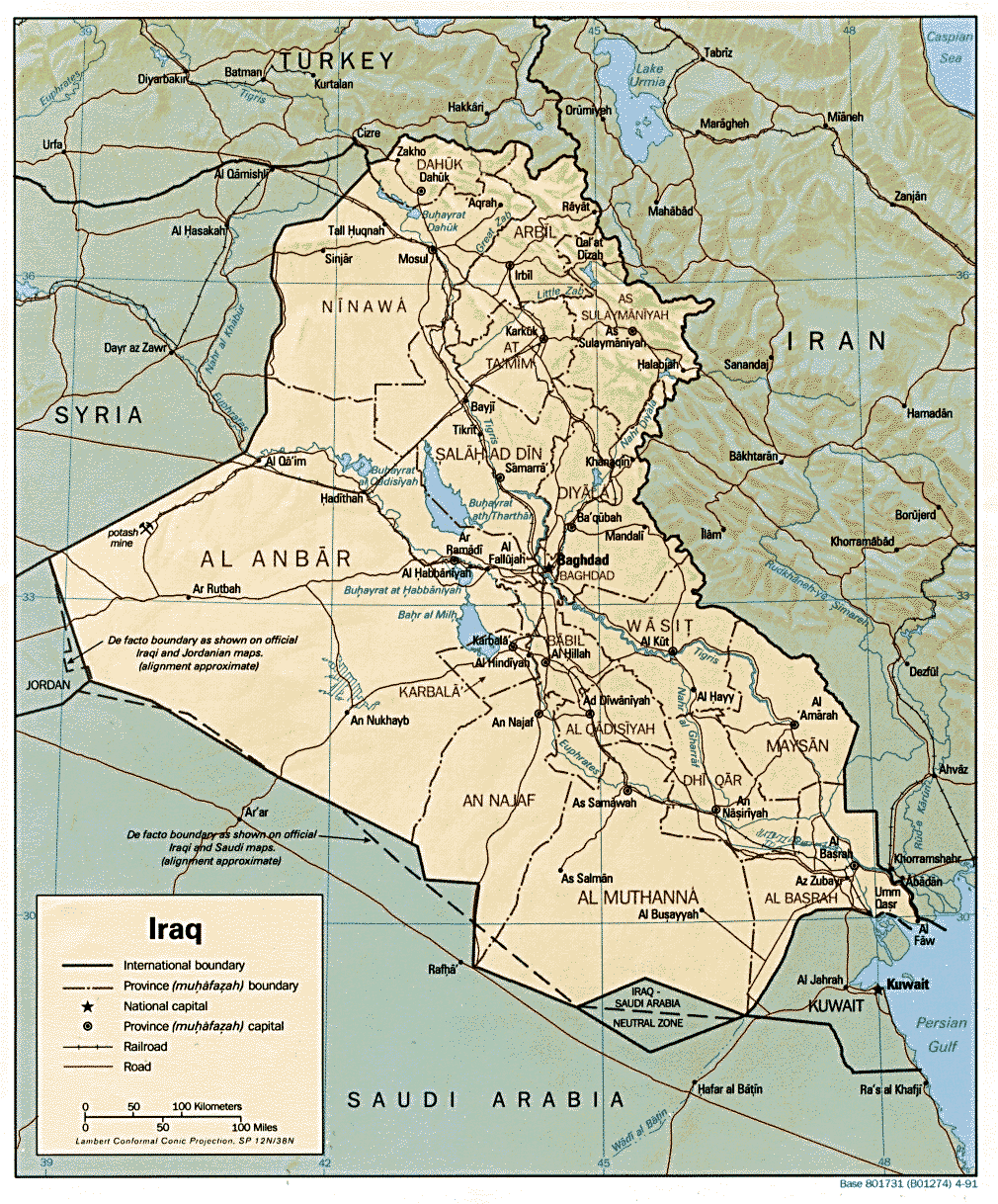

May 2010
April 2010
March 2010
February 2010
January 2010
December 2009
November 2009
October 2009
September 2009
August 2009
July 2009
News:
The Globe and Mail
The Star
The Wash. Post
Opinion:
TNR
Slate
Washington Monthly
Rants:
Canadians
Penny
Janes
Cosh
The Hound
Coyne
Wells
Farrell, etc.
Steyn
Levant
Afghanistan
The Torch
Abu M.
Bill & Bob
Ghosts of Alex
Registan
Jari
Ink Spots
Ackerman
Kings
FRI
Embedded
Milnews.ca
Can-AFG
The Capt.
Etc.
TMLutas
Sullivan
Marshall
Kaus
Lileks
Reynolds
Welch
Farber
The Shark
Breen
Henley
Electrolite
Samizdata
Slotman
Simberg
Northrup
Bryant
Yglesias
Cole
Drum
Clients/Employers
(Past and Present):
U of T
Cdn. Forces
CG Magazine
LRC
Adrenaline Vault